The History of Rainier Beer - part 2
|
|
|
|
|
|
|
When beer was legalized on April 7, 1933, this was actually not the end of Prohibition. On that date the Cullen-Harrison Act went into effect, allowing the sale of 3.2% beer. It was not until Dec. 5, 1933 that repeal of the Eighteenth Amendment was ratified. It then became legal to produce and sell pre-prohibition "full strength" beer.
Joseph Goldie, Rainier's chairman of the board, stated that "....the brewery had enough 5½% beer in aging tanks to release thousands of cases of their Pale Beer in anticipation of Repeal." He described this pre-prohibition style as a pilsner-type beer that originated in old Austria, and was made with low-kiln-dried malt and Bohemian, Saazer hops.
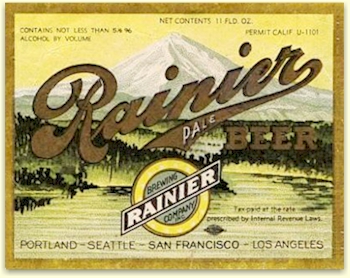
 The Rainier Pale Beer
label, shown above (left) gives the actual strength - a practice
that
The Rainier Pale Beer
label, shown above (left) gives the actual strength - a practice
that is no longer allowed. With the May 1935
merger of Seattle and San Francisco creating a new company- Seattle
Brewing & Malting- a more colorful version of the 1906 label was adopted
(right). The "Pale" designation was only on the neck label. This version first appeared on July 4, 1935 in both cities, but San
Francisco soon dropped it in favor of its new Special Export.
is no longer allowed. With the May 1935
merger of Seattle and San Francisco creating a new company- Seattle
Brewing & Malting- a more colorful version of the 1906 label was adopted
(right). The "Pale" designation was only on the neck label. This version first appeared on July 4, 1935 in both cities, but San
Francisco soon dropped it in favor of its new Special Export.
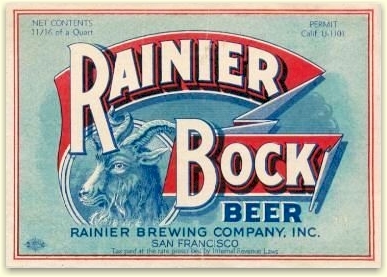
Each spring it's traditional for breweries to offer a Bock beer, and Rainier was the first to release its own version. The January 1934 ad for Rainier Bock is shown here (left), and the first Bock label used by Rainier is shown above.
 The
Hetch Hetchy brand was registered in Nov. 1934 and appears to have been
a special bottling to celebrate the completition of the Hetch Hetchy
Reservoir Project. It was then that mountain water began to flow 167
miles from the northewest corner of the Yosemite National Park to the
San Francisco Bay area.
The
Hetch Hetchy brand was registered in Nov. 1934 and appears to have been
a special bottling to celebrate the completition of the Hetch Hetchy
Reservoir Project. It was then that mountain water began to flow 167
miles from the northewest corner of the Yosemite National Park to the
San Francisco Bay area.
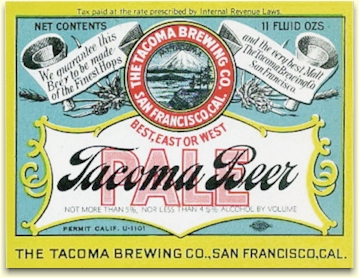
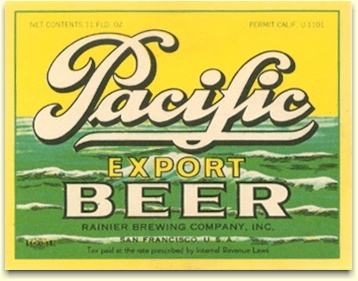
To further utilize the brewery's huge production capabilities, Rainier produced two other brands that they acquired with the 1927 purchase of the Tacoma Brewery. Tacoma Pale Beer and Pacific Export Beer were marketed under the names, Tacoma Brewing Co. and Pacific Products respectively, until 1935 when they dropped this practice in favor of Rainier Brewing Co., Inc. They continued with the Tacoma and Pacific brands into the early '40s.
|
|
|
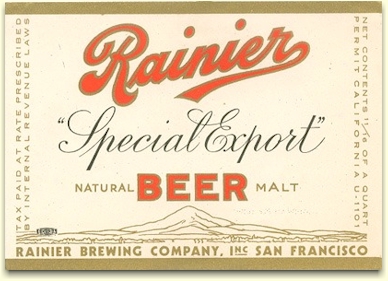
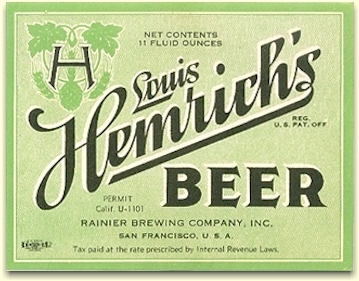
In April of '35, Rainier introduced it's "Special Export - a natural malt beer" (below left) with the slogan: "A lift without a letdown." Special Export remained a primary brand into the '50s. A couple of other products were early brands, one named after the president, and chairman of the Board, Louis Hemrich (below right).
|
|
|
|
|
|
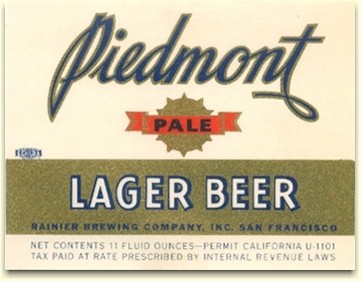
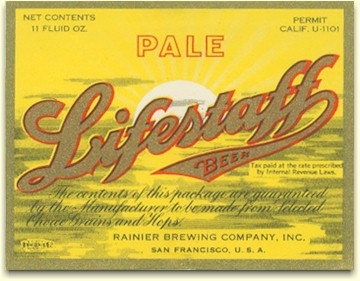
Two other budget brands were early products, Piedmont Pale Lager Beer (above left), and Pale Lifestaff Beer (above right). Lifestaff was a brand used by Louis and brother, Alvin's Hemrich Staff Products Co. during Prohibition. Alvin chose Hemrich's Select as the flagship brand of his Hemrich Brewing Co. and dropped Lifestaff but received a partial royalty for its use by the SF brewery.
 To further utilize the plant's
capacity, the company contracted with wholesalers and grocers to produce
private label brands. These beers included Full Value, Gold Medal, Ace
Hi, Tornberg's Old German Lager, Old Vienna, Old
Mission Steam Beer, Brown Derby, Leideg's De Luxe, Lisco Lager, Piedmont
Pale, Schwartz & Weiss, Krug, BB Special Export, Shorty Roberts' Tally Ho,
and Pilsen Brau.
To further utilize the plant's
capacity, the company contracted with wholesalers and grocers to produce
private label brands. These beers included Full Value, Gold Medal, Ace
Hi, Tornberg's Old German Lager, Old Vienna, Old
Mission Steam Beer, Brown Derby, Leideg's De Luxe, Lisco Lager, Piedmont
Pale, Schwartz & Weiss, Krug, BB Special Export, Shorty Roberts' Tally Ho,
and Pilsen Brau.
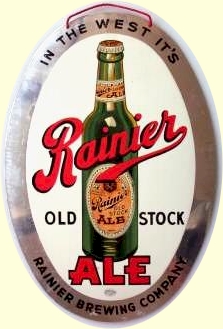
In October of '34, the company introduced its English Type, Old Stock Ale (left). It was advertised as Rainier Beer's "Big Brother" containing 6% alcohol. About this time they adopted the tag line: "In the West it's Rainier Beer" (or Ale).
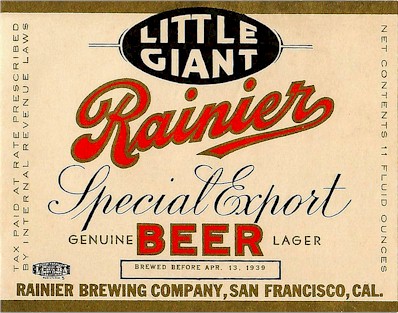 With the introduction of the Stubby bottle in Dec. of 1935, brewers were
quick to adopt this more versitile package. In Dec. of '36, Rainier traded
the long neck for the Stubby, reintroducing their Special Export in the
package they called a "Little Giant." They dropped the Little Giant
version in mid-1942.
With the introduction of the Stubby bottle in Dec. of 1935, brewers were
quick to adopt this more versitile package. In Dec. of '36, Rainier traded
the long neck for the Stubby, reintroducing their Special Export in the
package they called a "Little Giant." They dropped the Little Giant
version in mid-1942.

In
February of 1936, Special Export was available both in bottle, and in the
new Low-profile, cone top cans. It was soon
followed by Old Stock Ale - also in the Continental Can Company's
"Cap-Sealed" beer can.
 By May of '36, Rainier Dark had been dropped
from the line-up and replaced with
their Extra Export Stout.
By May of '36, Rainier Dark had been dropped
from the line-up and replaced with
their Extra Export Stout.
From 1926 to 1932, it was available as a low alcohol product.
This label is identical to the earlier version with the exception of the
"alcoholic content less than ½ of 1% by volume" statement on the original.
Hemrich had tried this full strength product in 1922, in Kamloops, B.C., but it didn't take off. This later attempt failed as well. It would seem that a stout, like the famous Guinness Stout, wouldn't gain acceptance until the early 1980s when craft breweries would appear on the scene.

In Sept. of '37, the company test marketed a new brand in the San Francisco Bay Area called Rainier Club Pale Lager. The brand was well received, and in the summer of '38, Rainier Club was launched with a new label (right) - which would remain a flagship brand until Feb. of '49.
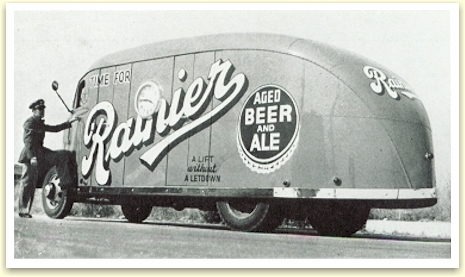
One of ten 1937 GMC Streamlines
produced for Rainier
The Rainier Brewing Company (1938-1953)
December 1, 1937, the company did a reorganization raising their capital from $1.5M to $2.5M and dropping "Inc." from their masthead.
 The line-up of brands
stayed constant until early December of 1940, when Half & Half was
introduced. It was offered in a 22 oz. bottle, and a new 8oz. size that came
in a slope shouldered bottle. Half & Half was described in the 9 December
press release as a blend of ale and porter, and that...
The line-up of brands
stayed constant until early December of 1940, when Half & Half was
introduced. It was offered in a 22 oz. bottle, and a new 8oz. size that came
in a slope shouldered bottle. Half & Half was described in the 9 December
press release as a blend of ale and porter, and that...
"Rainier Half and Half is the result of eighteen months of experiments on the part of Rainier's scientific staff to develop a half and half blend which would exactly meet the western taste."
Perhaps they didn't get it exactly right, since Rainier Half & Half
was gone by August of 1942.
The war years were tough on all the California brewers, given the
shortages in materials, but Rainier better than most. In '42, they made a
move to increase their market share in southern California. The July 22nd
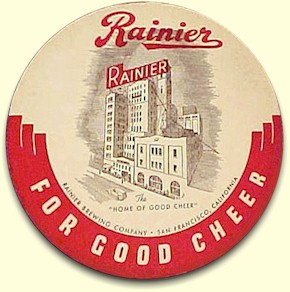
issue of the San Francisco Chronicle ran the following story: 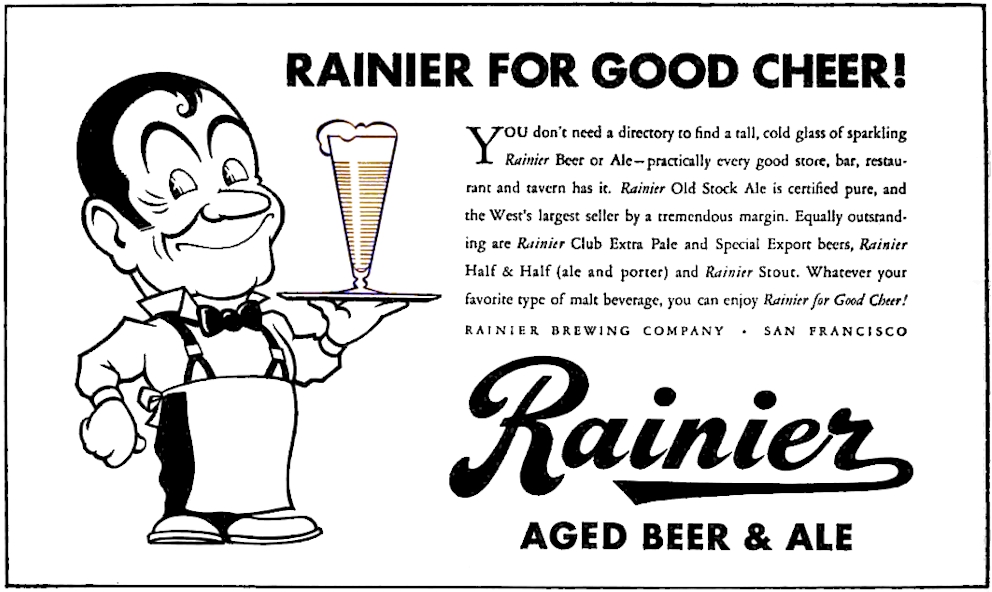 In Oct. '39, the slogan "Rainier - For Good Cheer" was introduced, and
continued in use until early '46. In Sept. of 1940, the company made
another major change when they streamlined the iconic Rainier logo.
Compare the logo in the 1941 Bock label (below) with the Half &
Half
label above (right). You'll notice that "Rainier" is now
horizontal, the font is thinner, and the curve has been removed from the
tail.
In Oct. '39, the slogan "Rainier - For Good Cheer" was introduced, and
continued in use until early '46. In Sept. of 1940, the company made
another major change when they streamlined the iconic Rainier logo.
Compare the logo in the 1941 Bock label (below) with the Half &
Half
label above (right). You'll notice that "Rainier" is now
horizontal, the font is thinner, and the curve has been removed from the
tail.
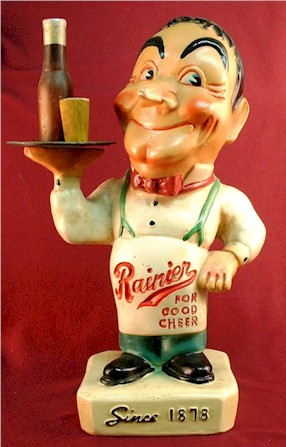
The waiter character in the early 1941 ad was a popular figure and
Rainier had him made into a back-bar, point-of-sale, chalk figurine. He came
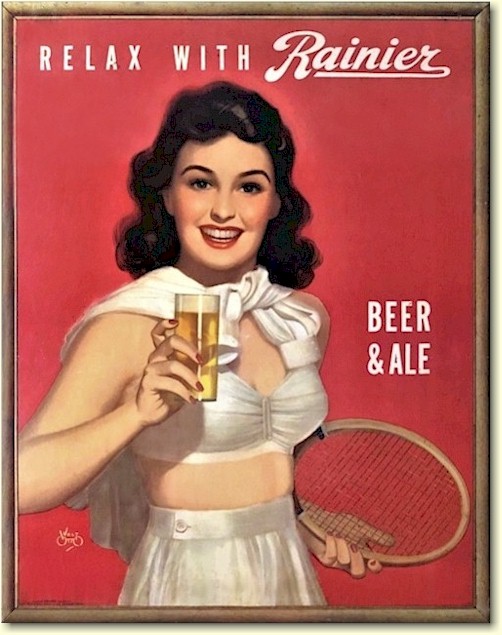
in 8" and 13½" sizes. See Breweriana (below). Also shown below is a poster from the early '40s, of a young female
tennis player and the slogan: "Relax with Rainier".
Also shown below is a poster from the early '40s, of a young female
tennis player and the slogan: "Relax with Rainier".
Rainier was still brewing Bock beer every Spring and this label (right),
ca.1941, displays the modified Rainier logo.
"Rainier Brewing Company of San Francisco, one of the oldest and
largest brewing organizations on the Pacific coast, has purchased the
entire plant of the Vernon Brewing Company of Los Angeles, it was
announced yesterday.
Acquisition of the Vernon plant is the initial move by Rainier in its
plans to increase distribution in Southern California, Joseph Goldie,
president, states. The Vernon brewery is less than 10 years old and is
equipped with the most modern brewery equipment obtainable.
The plant occupies approximately an acre of ground and in addition
Rainier has acquired an acre of vacant land adjoining, which it plans to
use in enlarging the capacity of the brewery as soon as materials and
equipment become available.
Rainier has already begun brewing in the Vernon plant, but no deliveries
of beer will be made from the new plant for some time."
The statement of "...enlarging of the capacity of the brewery as soon as materials and equipment become available" refers to the war time shortages of essential materials. However, by the time materials and equipment did become available, Rainier was struggling and no expansion of the plant occurred.
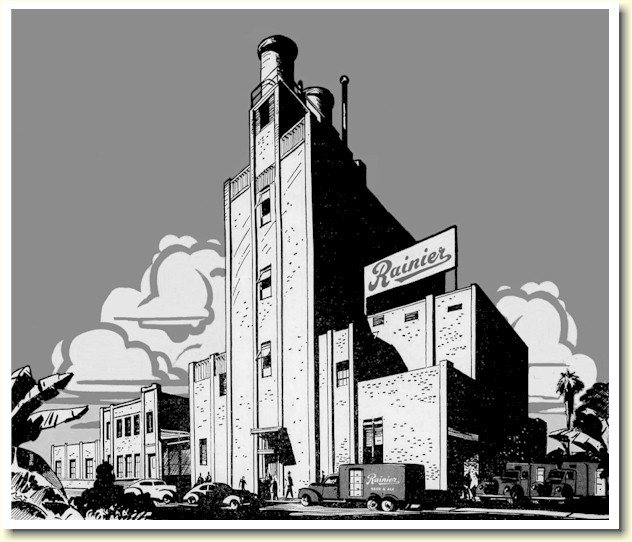
illustration for an Aug. 1942 ad
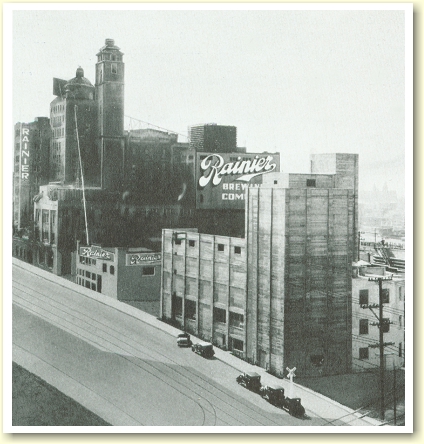
This artist's rendition makes the new brewery look rather grand, but the newspaper photo (below) shows that it was a fairly small plant.
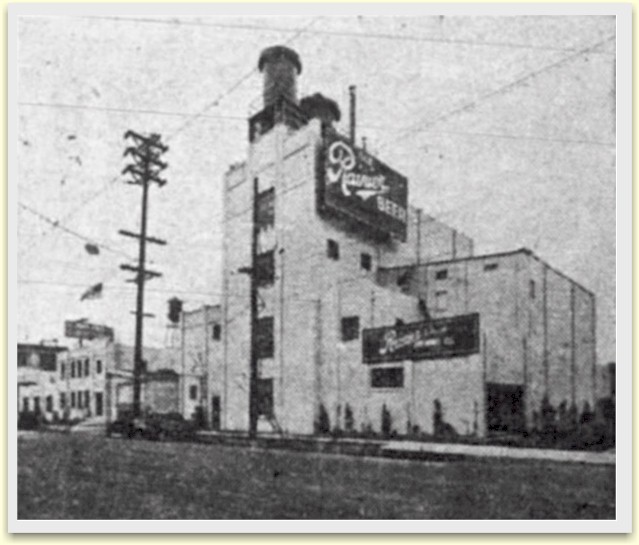
Does anyone have a good photo of the Rainier plant?
|
|
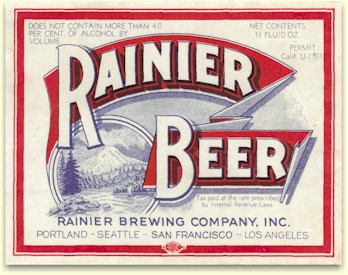
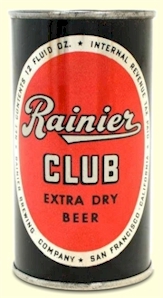
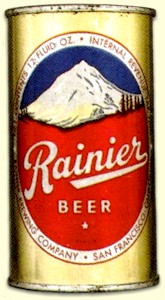
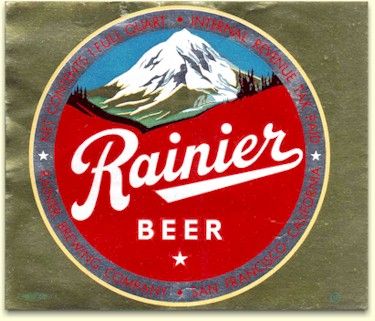
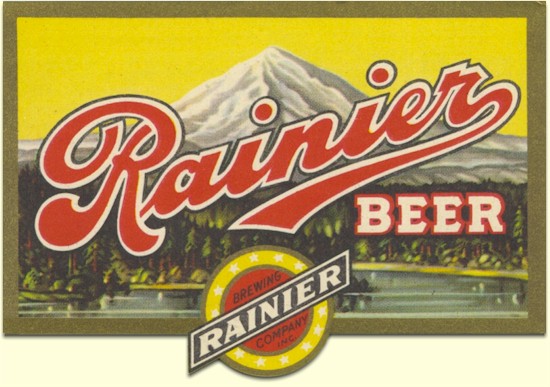
The post war era was not as good for Rainier as for some of their competitors, and they began losing market share. In early 1947 they brought on a new brewmaster, Nicholas Vacano. That May he re-formulated their mainstay, Rainier Club Extra Pale Beer and called it Extra Dry. He claimed that they "Fermented out the solids" which was marketing speak for - "here's a beer made by replacing expensive malt with cheaper adjuncts." The canned Rainier Club Extra Dry Beer is show here (at left). Apparently the public was not impressed with "Dry" beer, and by late '48 the product was dropped and Extra Pale was back. Also axed was the company's brewmaster! But Rainier Club Extra Pale didn't last long either. In February of '49 the new brewmaster introduced Rainier Beer - with a more colorful label that also featured a prominent image of Mt. Rainier, and a return to the angled logo, shown on can (right) and labels (below). |
|
|
|
|
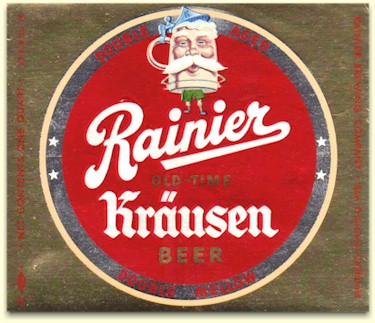
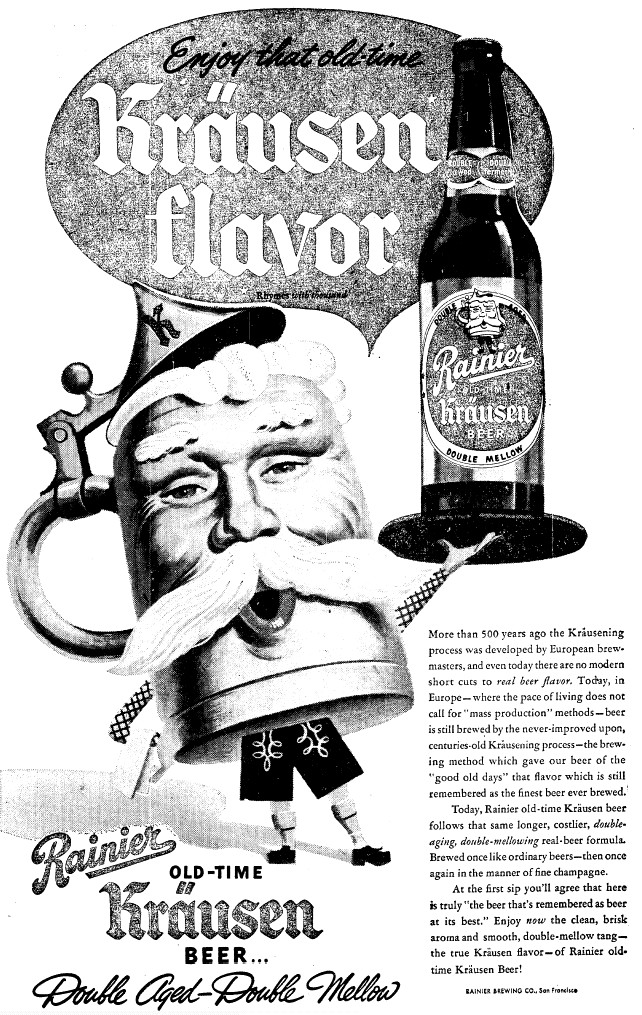 In May of '51
another product appeared - Rainier Old Time Kuäusen Beer - shown in the ad
(right) and label (above), but it was too little, too
late. The introduction of new brands and more colorful packaging did nothing
to slow the loss of market share to
Lucky Lager , as well as to the penetration of eastern brewers. That,
combined with some questionable business practices, led to the demise of the
Rainier Brewing Company of San Francisco.
In May of '51
another product appeared - Rainier Old Time Kuäusen Beer - shown in the ad
(right) and label (above), but it was too little, too
late. The introduction of new brands and more colorful packaging did nothing
to slow the loss of market share to
Lucky Lager , as well as to the penetration of eastern brewers. That,
combined with some questionable business practices, led to the demise of the
Rainier Brewing Company of San Francisco.
On July 22, 1953, the Rainier Brewing Co. was purchased by Emil G. Sick, who then sold the San Francisco plant to the Theo. Hamm Brewing Co. of MN, retaining sole rights to the Rainier brand. In a matter of one month Rainier Beer was again available in California, but it was now brewed in its birthplace of Seattle.
The Los Angeles plant was also sold but was never again used as a brewery.
|
|
|
|
|
|
|
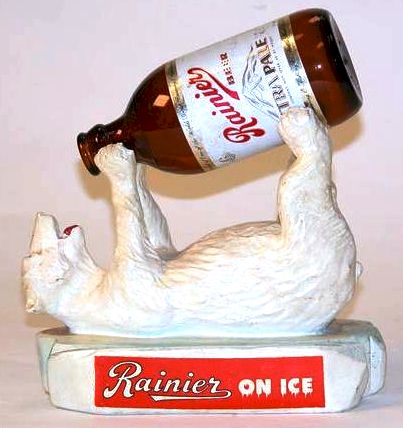
Polar Bear back-bar figurine, ca.1949

Emil Sick was responsible for returning the venerable brand back to the place of its birth, but it was a struggle that lasted 20 years and cost him over a million dollars.
With the end of Prohibition this Canadian brewer sought opportunities in the U.S. market. He began with the 1933 acquisition of three breweries in Montana. First he formed a partnership with the owners of the Montana Brewing Co. and the American Brewing & Malting Co., two Great Falls firms dating from the 1890s. They turned the Montana Brg. plant into a malt house, and the American plant into the primary - thus forming Great Falls Breweries, Inc. They remained a part of the Sick empire until September of 1949 when Sick returned control to the Jensen and Johnson partners.
Next he partnered with the owners of the old Garden City Brewery in Missoula. The new company was established as the Missoula Brewing Co. The brewery remained a Sick satellite for 16 years. Then, at the same time he relinquished his interest in his Great Falls holdings, he sold his shares back to the Steinbrenner family. The Missoula Brg. Co. was then more commonly referred to as the Highland Brewing Co.
Sick then joined forces with an old friend, Harry Goetz, and re-opened the old
Henco Brewery in Spokane. Demand soon exceeded the plants capacity and in
December of 1936 they bought the old Galland-Burke Brewery, establishing
Spokane Breweries, Inc. While Rainier was never brewed in Montana, it was
produced in Spokane until Sick closed the plant in 1962.
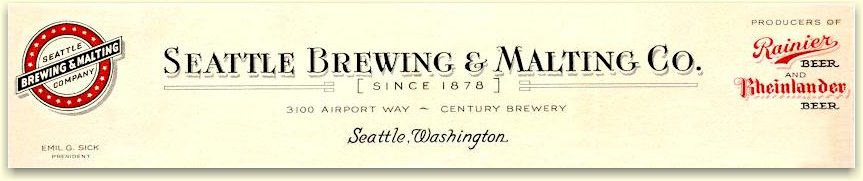
letterhead ca.1938
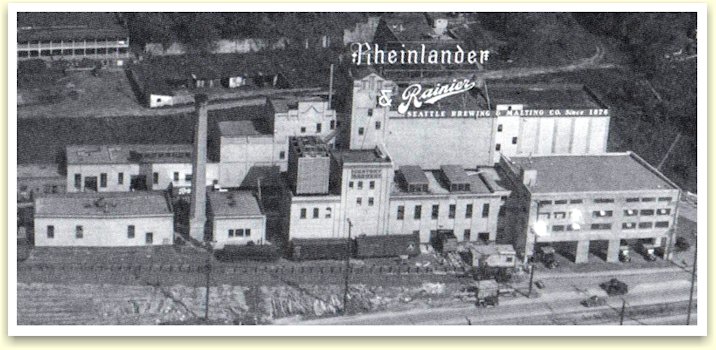
With the repeal of Prohibition in 1933, Emil Sick established the Century Brewing Assn. and purchased the old Bay View Brewery in Seattle. The Sick organization chose "Rheinlander" for the Century Brewery's flagship brand. They used the tag line: "The tang of the Rhein, for the Beer of the Century."
For more on the Rheinlander brand, go to Rheinlander Breweries of Seattle.
At this time Rainier Beer was being distributed in
Washington by the Rainier Brewing Co. of San Francisco. On May 1st of 1935, Emil Sick and
Rainier's Louis Hemrich agreed
to a $2M licensing agreement which allowed
Sick to brew and market Rainier Beer in Washington and Alaska under a
royalty arrangement. The name of the company was then changed from Century
Brewing to Seattle
Brewing & Malting.
Rainier then became the flagship brand but the Rheinlander brand was
continued until 1938, when it was moved to a different plant. The
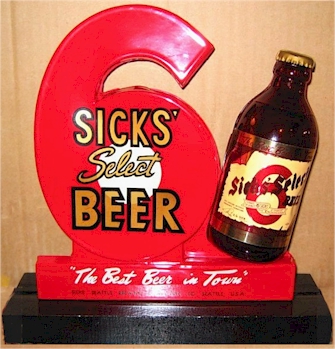
following year "Sick's Select" was added to the company's line-up.
|
|
|
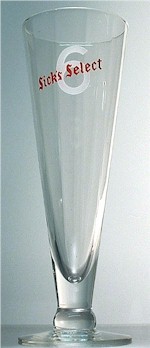
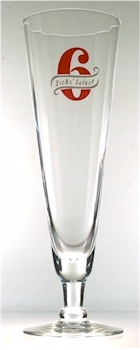
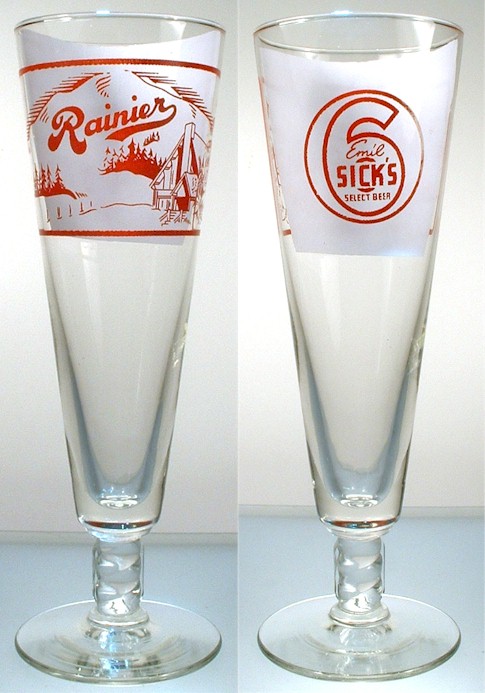 Beer glass with both Sick's Select and Rainier logos, Nov. 1941 to Dec. 1943. |

In 1944, Sick's was replaced by Sicks' and added to the names of all the breweries in the parent corporation. This remained in effect until the 1970 purchase by Heilman.
|
|
|
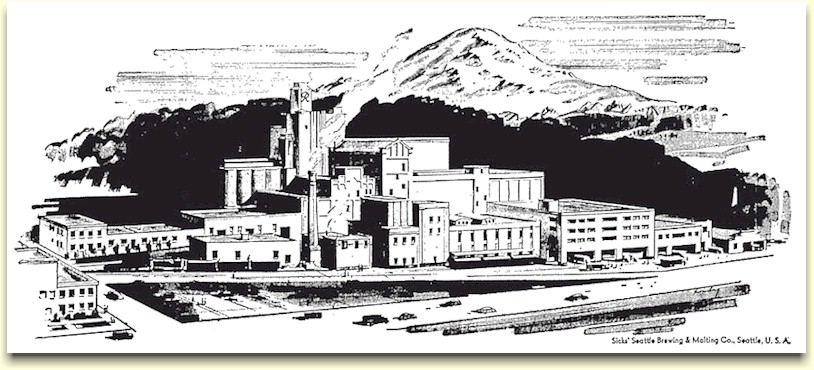
Rainier Brewery,
pen & ink drawing, ca.1953
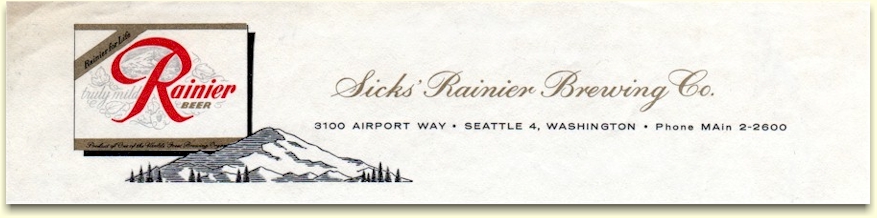
Rainier Brewery letterhead ca.1963
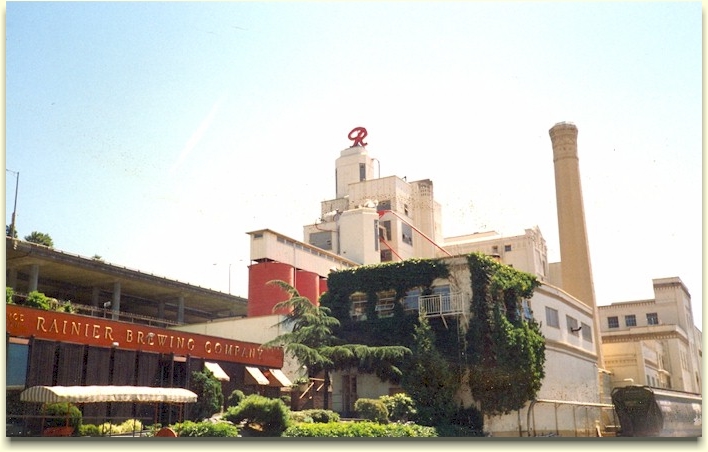
Rainier Brewery ca.1990
Article by

|
|
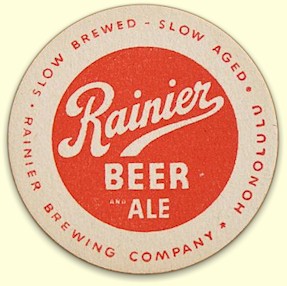
Rainier coaster from Honolulu ca.1937. Go to: MISC. COASTERS |
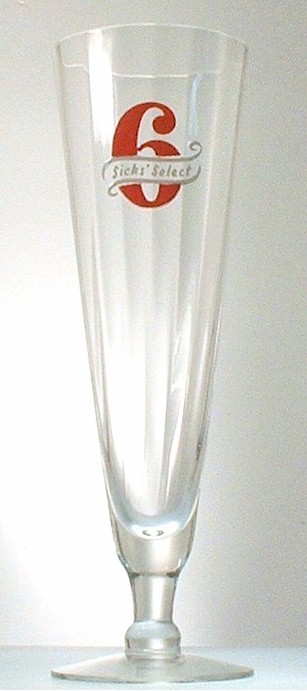  |
Post-Prohibition beer glasses from Seattle - Go to: GLASSES |
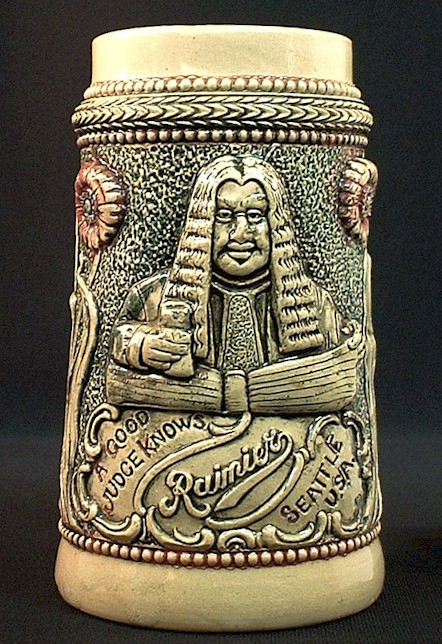 |
Pre-Prohibition stein - Go to: MUGS |
A book on the history of the Rainier brand is underway ......
so there may not be many changes to this page.
Occasionally I'm asked if Rainier is still being brewed. The answer is yes and no! Of course there is no longer beer flowing from the Seattle plant, however the Pabst Brewing Company still owns and markets the brand. Currently the Miller Brewing Company has been contracted by Pabst to produce Rainier Beer in their Irwindale, CA. So yes, you can still get a Rainier Beer! But you have to contact Pabst to find out if it's sold in your area - e-mail: products@Pabst.com or call: (800) 947-2278
But for those of you nostalgic for the classic Rainier commercial of the
motorcycle..
ACKNOWLEDGEMENTS
For any comments, additions, or corrections -
All contents including images are copyright by BreweryGems.com |