The only immediate competition
from a brewer in Washington State was from Alvin's oldest son, Elmer.
Following his father's lead, Elmer had made a preemptive move in purchasing the
The only immediate competition
from a brewer in Washington State was from Alvin's oldest son, Elmer.
Following his father's lead, Elmer had made a preemptive move in purchasing the

Hemrich Brewing Company
(1934-1940)

letterhead, April 1938
|
Fortunately, Reifel had in his employ one Rudolph "Rudi"
Samet, who had a long history with the Hemrich family. Samet
was currently the manager of Reifel's Vancouver Breweries,
Ltd. The plant was located at 12th & Yew Sts., and was a
unit of his B.C. Breweries group.
Samet had been with the Hemrich family's
Seattle Brewing & Malting as early as 1904, when he managed SB&M's Bottling Depot. By
1908 he was their general manager. When state-wide Prohibition
shut them down in 1916, he moved to San Francisco to manage the Hemrich's new
Rainier Brewery.
Just four years later they were shut down once more, this time by
national Prohibition.
British Columbia had a four year experiment with Prohibition, which
ended in 1921. By 1924, Samet had relocated to Canada and was
hired as general manager of a brewery owned by, what would become,
Coast Breweries of Vancouver, Ltd.
This
long term association with the Hemrich family's brewing interests,
and his relationship with the Canadian brewers, explains how he
could broker the deal between Alvin Hemrich and Henry Reifel. Upon completion of the 31 May 1934 sale the plant was re-organized as the Hemrich Brewing & Investment Corp., operating as the Hemrich Brewing Co., still using U-Permit WA-1211. Samet became company president, and plant manager, while retaining his position as manager of Reifel's Vancouver plant. Lester R. McCash became the firms secretary.
In Emil Sick's 1958 memoirs he recalled the circumstances surrounding
Alvin Hemrich's sale of his plant No. 2:
On July 26, 1934, the new firm
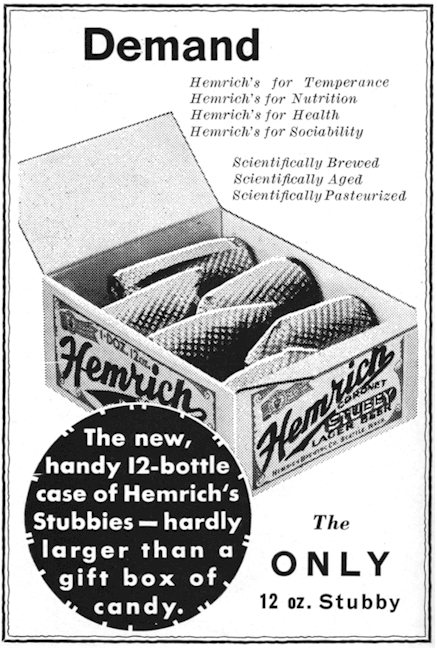
added Happy Peppy Beer as an alternative to their flagship label - Hemrich's Select. Then in June of '35 they
replaced Hemrich's Select with Hemrich
Coronet Lager Beer - made with Bohmeian hops blended with the local
Cascade hops.
On 25 March of
1936, the company got a some needed financial help when the capital
stock was increased to $250,000. At his time they changed the legal name
of the company from Hemrich B & I, to Hemrich Brewing Co. The Canadian
firm, British Columbia Breweries, Ltd. remained the majority
stockholder. But all was not well with the majority owners. Emil Sick
further recalled: "
|

 In December of 1935, the

|
By now they were also offering draught lager beer in 32 oz.
"Jumbo" versions. Coronet was also available in either quart
or half-gallon size bottles. No Hemrich beers were ever offered
in cans. I can't imagine what possessed Samet to market a beer called Happy Peppy. Perhaps he felt that the housewife would go to the store and decide she would like to make her man happy & peppy! But the majority of beer sales were still in the taverns. I can just see a longshoreman or a steel worker getting off work and stopping off at the local tavern and saying to the barkeep: "Gimme a Happy Peppy" - I don't think so! To replace Happy Peppy beer, they announced their new creation - Jockey Club Lager Beer (label below). The roll-out was scheduled for the 4th of July, 1937. The new lager would be available on draught, in stubbies or steines, and in 32 & 64 oz. bottles. Oddly, the first labels contained "Permit No. WN U-1211" for the Hemrich Investment Corp., but U-Permits were not required after 1935. The new Jockey Club brand did improve sales, but only marginally. Then in May of 1939, they announced the release of a new Hemrich's Select with a new label similar to the parchment scroll look of their Coronet brand, and with the slogan: "The Light Beer in the Dark Bottle." The new Hemrich's was offered in steinies and exports (long necks), or jumbo quarts and half-gallons - which had a different label (see below). Their brewmaster, Hugo Bodie, formulated this beer that was purported to have the qualities of both eastern and western beers. Whether they accomplished that or not was moot, as it was too little, too late.
In spite of the early restructuring, changes in brand promotion,
and gambling games (see below) with the labels, nothing did enough to save
the company. With sales dwindling and losses mounting, the
Canadian backers had finally had enough and decided to sell the
company.
With that, Rudi said, "It's a deal," and we shook hands. Soon after--I think it was 1939--Lester McCash came over to us to save all of the Hemrich business possible, and, in various capacities, he has remained with us over these many years."
McCash did leave the Hemrich Brewing Co. in 1939. He was an agent for Emil
Sick in the purchase of the Horluck Brewing Co. in April of '39, which he
then converted and managed as the new
Century Brewery.
The very last bottle to come off the line was saved by the
Bottling Shop's supervisor, George Popovich. George went on to
become production supervisor for Glaser Beverages. Coincidently,
Paul Glaser had been the manager of
Hemrich's Staff Products Co. during Prohibition. The plant's brewmaster, Hugo Bode, retired after the brewery closure. However, his assistant, Hugo, Jr., relocated to Nampa, ID to take a Brewmaster position with the old Cresent Brewery, now operating as the Overland Beverage Co.
FOOTNOTES: ¹ |

 Emil
Sick commented further:
Emil
Sick commented further:
BREWERIANA FROM THE HEMRICH BRG. CO.

Happy Peppy wooden sign, issued in 13" or 40" dia.

Jockey Club reverse-on-glass sign

Hemrich's Select Beer label ca.1939, with poker hand behind tear-off panel -
used on the 11 oz. long neck and the 12 oz. steinies

both the 32 oz. Jumbo, and the
Half-Gallon used this style label, ca.1939


Hemrich's Beer neon sign

Hemrich Coronet Lager
tin-over-cardboard (TOC) beer sign

Hemrich's Beer, 15" diameter, reverse-on-glass lens for lighted sign


Hemrich's Select Beer, copper cap lifter

Hemrich's Beer, 4" employee patch

|
All contents including images are copyright by BreweryGems.com |