

Aberdeen Brewery, ca.1907
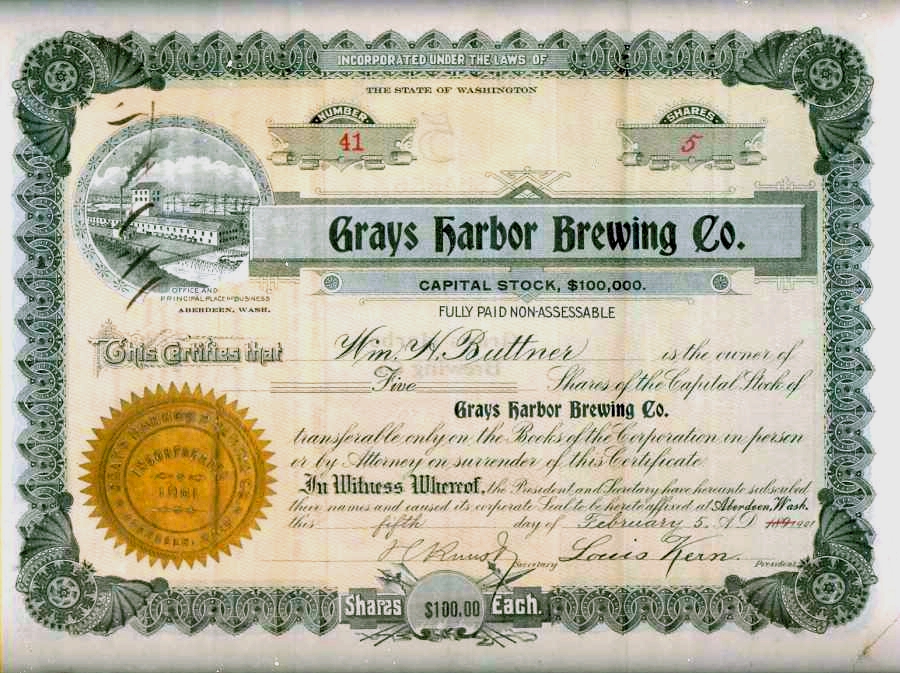 In 1900 an investment group, headed by
Louis Kern, did proceed with a similar plan and established the
Grays
Harbor Brewing Company. The plant, with a 100,000 barrel capacity, was
planned and started by German brewmaster, Ernest Bloch. The new company was incorporated in
1901. A stock certificate (left), signed by Kern on the 5th of
February, 1901, shows an image of the planned, wooden frame plant.
In 1900 an investment group, headed by
Louis Kern, did proceed with a similar plan and established the
Grays
Harbor Brewing Company. The plant, with a 100,000 barrel capacity, was
planned and started by German brewmaster, Ernest Bloch. The new company was incorporated in
1901. A stock certificate (left), signed by Kern on the 5th of
February, 1901, shows an image of the planned, wooden frame plant. However, the
Alvin organized a stock company (that included his brother Louis), which
was incorporated with a capital stock of sixty thousand dollars. The
first officers of the company were Alvin Hemrich, president; E. J.
Guaver, secretary and manager: and H. L. Smith, treasurer.
By
the time production commenced, in May of 1902, Alvin had dropped the
name Grays Harbor Brewing Co. in favor of the Aberdeen Brewing Company.
He had also hired brewmaster, Ernest Bloch, as manager of the plant.
Bloch had overseen the start-up of the Claussen
Brewing Assn. in Seattle.
The first draught beer was placed on the market on May 21st, and was warmly received. However, their bottling works was not fully operational until early July. The bottling line had a capacity of 10 barrels, or 1680 quart bottles per day.
The first bottles were filled on July 8th and promptly delivered to local outlets. Their first ad was run on the 21st of July and announced: "Aberdeen Brewing Co.'s - Bottle Beer! Is now on the market in Pints and Quarts. It Has No Equal. Telephone 901. Ask for our A.B.C. Prima."
The firm also obtained a contract with the Eagle Brewing Co. of S.F. to bottle their "Prima Lager" for Bay Area distribution. On the 9th of July of '02, 100 barrels were shipped to San Francisco on the steamer Santa Monica.
 The brewery's output for the first year was
8,500 barrels, a significant amount of which was exported to San
Francisco. The initial capacity of the plant was 50 barrels of beer per
day, and much to Mr. Hemrich's surprise he found that an increase in
capacity was necessary to meet the immediate demand. Within months of
opening he was purchasing the necessary equipment to double the plant's
output to 100 barrels per day. He also found it necessary to increase
the bottling works capacity. The capital expenditure now equaled
$100,000.
The brewery's output for the first year was
8,500 barrels, a significant amount of which was exported to San
Francisco. The initial capacity of the plant was 50 barrels of beer per
day, and much to Mr. Hemrich's surprise he found that an increase in
capacity was necessary to meet the immediate demand. Within months of
opening he was purchasing the necessary equipment to double the plant's
output to 100 barrels per day. He also found it necessary to increase
the bottling works capacity. The capital expenditure now equaled
$100,000.
With an improved bottling plant they found it more profitable to bottle
their own beer and ship casks packed full of cork-finished bottles to
their San Francisco distributor.
The weekly shipments, by water and rail, consisted of approximately 100
casks. Each cask contained six dozen quarts of beer, which were packed
in sawdust for protection.
Their promotional literature stated:
"OUR BEER IS HONESTLY MADE - That means careful brewing, purity of ingredients, cleanliness, proper aging. We do not sacrifice any of these essentials to save expense. That would be a short-sighted policy. The quality of the beer must be maintained.
You get the full value of your money in every glass of Prima Beer you buy. It is healthful, nourishing and satisfying. Send for a trial case today."
A trial case certainly sounds reasonable! And to counter Olympia's
slogan, "It's the Water" - Aberdeen claimed that "It's the Material."
That sounds reasonable as well!
The Prima brand was used by other
brewers to describe their beer, as it's the German slang word for
"excellent." However, the only Prima Beer in the Northwest was from Hemrich's Aberdeen Brewing Co.


Embossed bottles ca.
1902-1906.

Another slogan - that sounds like wishful thinking - is stated in the ad
above: "It's the Beer that makes Milwaukee
Jealous." I would be surprised if anyone in
Milwaukee even knew where Aberdeen was, let alone having tasted their
beer! But I'm sure that it made the fishermen and lumbermen feel lucky
to have such a fine product available locally. In addition to "Prima"
lager beer and "Aberdeen Porter" the brewery also produced a "Golden
Age" lager beer. The Aberdeen Herald printed an ad that said:
"For Brain and Brawn Drink Golden Age Bottle Beer - Healthful and Pure."
This brand can be seen advertised on the stag tray and label shown
above.
 By 1906, the brewery employed 25 people, and produced $200,000 worth of beer
a year. Increased sales
and demand required even further expansion. In order to increase
capacity an annex to the plant was erected in June 1907.
By 1906, the brewery employed 25 people, and produced $200,000 worth of beer
a year. Increased sales
and demand required even further expansion. In order to increase
capacity an annex to the plant was erected in June 1907.
The brewery had also installed a new ice plant, which was then
consolidated with the two other plants of the city. They were now
supplying all the ice for the Aberdeen area, and were selling as much
ice as beer.The water for the brewery and ice plant came from their own well, sunk
200 feet deep in order to tap the aquifer far below the bottom of the
harbor and sealed off from the salt water by a thick layer of hardpan.
In May of '08 they drilled an additional well at a cost of $2000.
The company purchased a Witteman carbonating outfit in 1907 and began
producing a line of sodas under their "Prima" brand, as well as a
product called "Puritas Water." A Daily Bulletin ad on 31 October
announced: "Puritas Water delivered at your home.
Costs but a trifle." Two years prior they had obtained a Witteman
"gas collecting outfit" which was used in the brewing process.

Now with the added capacity the brewery was able to fill contracts with other sellers. One example is "Glenweiser Beer" which they brewed for the Crescent Bottling Works.

Alvin Hemrich was assisted by his son Elmer who, by 1910, had become proficient enough to assume the post of assistant manager of the Aberdeen plant. In the following year, just prior to his twenty-first birthday, he was placed in full charge of the brewery. With Elmer now manager and vice-president of the brewery, Alvin was free to devote all his attention to his other responsibilities in Seattle as president of both the Hemrich Bros. Brewing Co. and of the Claussen Brewing Association.
Concurrent with Elmer assuming greater responsibilities was the introduction of a new product. On the 11th of March, 1911, the Grays Harbor Post published an announcement that the Brewery was now offering a dark Bavarian-style beer called "Original Erlanger."


However, Prima remained their flagship brand and was considered a
premium beer. It must have been an excellent product for it to compete
in the San Francisco market.
While Prima was the
best seller in the brewery's home market they did have competition from
other brands. The Crescent Bottling Works of Aberdeen and Centralia were
agents for the Independent Brewing Co. of
Seattle, and they distributed Independent's Old German Lager.
Additionally, they contracted with Independent to brew and bottle
Glenweiser Beer (mentioned above) which Crescent marketed as a budget brand.


perpetual calendar - Bryan Anderson collection

Hand-held dice
game


Match
safe with raised lettering on ends for striking match.
On top: "Golden Age Beer"
On Bottom: "Loggers Pal"
Prohibition
In 1915, Washington voted to go dry, with statewide Prohibition to go
into effect on January 1st, 1916. This terminated the production of all
alcoholic beverages - four years before national Prohibition. Most
breweries were forced to close or shift to another product line.
The Aberdeen Brewing Co. (ABC) announced that their Prima Bottling Works
division would be increasing production of soda waters. An example of one of
their soda siphon, or seltzer bottles, sporting an etched Prima logo is
shown at right.
Along with their bottling works the brewery still had a
high capacity refrigeration plant which allowed them to remain in the retail ice
business.
ABC also announced that they would be a introducing cereal beverage,
euphemistically called "near-beer." By law these beverages could contain
no more than ½ of 1% alcohol, and could not use the word "beer" on the
label.
In July of 1916, their first venture
with a cereal beverage was a contract brew for Brunn & Co. of Portland,
who was the Seattle Brewing & Malting (SB&M) agent in Oregon for their
Rainier Beer.

Since Alvin Hemrich owned an interest in SB&M, and Brunn & Co. was their Oregon agent, they were granted temporary use of the Rainier brand. However, they wern't to use the same graphics as the Rainier Beer label. Mt. Rainier was not used and the color scheme was slightly differend - as was the font used for "Rainier." This product was only distributed in the Portland and Pendelton markets from July 1916 to April 1917.
Once SB&M's Rainier Products was
established at the Georgetown plant in Seattle, and its near-beer was released,
the use agreement would terminate. In April
1917, Rainier Product's "Rainier Special" was on the market. Brunn & Co.
then ceased the distribution of "Rainier Royal." Isaac Brunn
remained as agent for Rainier Products until Oct. of 1917.
Once the Brunn contract expired, the Aberdeen plant introdced their own brand of near-beer, called "Golden Age" the same as their
once popular brand of beer. At this same time Alvin Hemrich was
producing a near-beer called "Lifestaff" at his
Hemrich Bros. Brewery in Seattle.
North Coast Products - In 1918 a new business entity was formed when the Aberdeen Brewing Co. was dissolved, and the North Coast Products Co. purchased $2,091.46 worth of bottles and $1,753.50 worth of signs from the old company. Elmer Hemrich remained vice-president and treasurer, and continued manufacturing ice, soda waters, and a cereal beverage called "Hop Jack."
Ice Delivery Company - In 1920, the ice manufacturing part of the
business was sold
to Russell G. Hall, who had established the Hoquiam Ice Co. eight years earlier.
However, in 1924, the entire plant was sold to Hall, and North Coast Products was liquidated.
This divestiture allowed the Hemrichs to concentrate on their new ventures. They established
the Surf Packing Company, with razor clam canneries in Grays Harbor and Alaska. There was even
a Hemrich Bait Co., in Aberdeen for a short time.
sold
to Russell G. Hall, who had established the Hoquiam Ice Co. eight years earlier.
However, in 1924, the entire plant was sold to Hall, and North Coast Products was liquidated.
This divestiture allowed the Hemrichs to concentrate on their new ventures. They established
the Surf Packing Company, with razor clam canneries in Grays Harbor and Alaska. There was even
a Hemrich Bait Co., in Aberdeen for a short time.
 Quinault
Products - At some point after taking control of the soda works, R.
G. Hall incorporated the Quinault Products Co. Their "Beverages of
Quality" included "Quinault Club Special Brew" which appears to have
been a near-beer. The principals in the company were Russell G. Hall,
president; M. T. Thorpe, vice-president; and Fred Amacher, secretary and
treasurer. Their brewmaster was Louis Marelich.
Quinault
Products - At some point after taking control of the soda works, R.
G. Hall incorporated the Quinault Products Co. Their "Beverages of
Quality" included "Quinault Club Special Brew" which appears to have
been a near-beer. The principals in the company were Russell G. Hall,
president; M. T. Thorpe, vice-president; and Fred Amacher, secretary and
treasurer. Their brewmaster was Louis Marelich.
With the repeal
of Prohibition eminent, Alvin and Elmer Hemrich were making plans to
re-enter the brewing business - but not in Aberdeen. Alvin was starting
up the Hemrich Brewing Co. in Seattle, and Elmer
(
Hall, and his partners were also planning to enter the
brewing business. With their experience brewing "Quinault Club" they
planned to re-open the brewery with the real thing.
Repeal
The 18th Amendment to the Constitution, which prohibited the
manufacture, sale, or transportation of alcoholic beverages, was
ratified in January 1919, to go into effect the following year, on the
16th of January 1920. Brewers believed that a product containing less
alcohol than their previous 6% brews would be permissible. This issue
was resolved by the Volstead Act of 28 October 1919, which established
the enforcement guidelines, and defined "alcoholic beverages" as those
containing more than "one-half of one percent" alcohol by volume.
However, this new law proved extraordinarily difficult to enforce, and
was routinely violated by respectable citizens. By 1931, Prohibition
remained largely un-enforced, and was deemed a failure. The public was
demanding action, and FDR was swept into office partly because of his
promise to end Prohibition. On 20 February 1933, only 12 days before taking office, the 21st Amendment was passed. However, the Repeal
amendment still required ratification by the states.
Then on 7 April
1933, the Volstead Act was amended by redefining the term "intoxicating
beverage". This change effectively ended Prohibition by legalizing a
beverage containing up to 3.2 percent alcohol. This allowed
brewers to
start production secure in the knowledge that real beer would be flowing
again. On the 5th of December 1933, the 21st Amendment was ratified,
overturning the 18th Amendment and ending Prohibition. Now
pre-prohibition strength beers of 6% could once again be brewed in
America.

Anticipating the promise of Repeal, renovations began at breweries all over the nation. The following is a newspaper account from Hoquiam's Washingtonian of 14 January 1933:
"Aberdeen, Jan.13 - Preparations for immediate manufacture of legal beer in Aberdeen at the Old Aberdeen Brewing company brewery were started today when crews of workmen began renovating the plant, it was announced by R. G. Hall. This is one of the four largest breweries in the state which survived the era of prohibition in Washington and which is being prepared for immediate manufacture of legal beer if congress passes legislation legalizing this product.
Although no announcement was available on plans under which the brewery will be operated it was made known that crews began today tearing out floors, repairing equipment and generally rehabilitating the brewery.
It was also revealed that Ernest Bloch, brewmaster who built the plant in 1901, is visiting the harbor with friends. Mr. Bloch is widely known in this district and the product of his vats turned out in pre-prohibition days was declared of recognized quality.
The brewery is adjacent to the Ice Delivery Company plant operated by Mr. Hall and the ice and heating equipment serves both.
Mr. Hall's announcement was made after workers began their task today and merely was that the plant was being put in shape and a set-up studied in preparation for any action by congress.
Other breweries which can be put into large scale production in this state are located in Spokane, Walla Walla, and Tacoma.
Mr. Hall indicated that when the plant is ready there will be a grand open house celebration for the whole harbor. He did not say whether or not pretzels will be served."
With the April 1933 revision of the Volstead Act permitting 3.2% beer, the nations brewers went into action - and the folks in Aberdeen were ready. Brewing began immediately so that after 60 days of lagering (aging) their beer would be available to a thirsty market.
The
firm was to begin operation as the Pioneer Brewing Company, Inc., but it
was also known as the Aberdeen Brewing Company - at least for the first
year. The Pioneer Brewing Co. was the first Washington State brewer to
apply for the newly required U-Permit - a government licensing number.
Their Wash-U-1200 can be found on early labels.
By the end of June
'33 Pioneer's first batch of beer was ready for consumption. The
following appeared in Aberdeen's Grays Harbor Post on 1 July
1933:
"Local Brew Is Now On Market -- Aberdeen's Newest Industrial Plant Make Deliveries To Local Retailers --Pioneer beer label, c.1934
Pioneer beer, Grays Harbor's locally manufactured brew, appeared on sale in Aberdeen and Hoquiam on Wednesday morning. About 200 cases comprised the initial delivery but the first-day supply was inadequate. However, additional deliveries are being made daily thereafter and an adequate supply for local consumption will be provided within a short time.
Deliveries of the new beer are being made in two new ton-and-a-half trucks just purchased from the Braley Motor Company, the latest type of panel delivery machines, brown in general color and with the name and insignia of the new company in gold leaf.
The brewery this week was the scene of intense activity as workers were busy getting ready for the start of delivery business on Wednesday. Many new workers have been added to the plant's crew.
The beer which went on sale Wednesday was started in April and is more than 60 days old, one of the oldest beers thus far put on the market here. It is a pilsner type, pale in color. The color is due to the natural brewing and aging process and to the fact that the beer is un-carbonated. It is the color of the higher grade pilsner, lager beers."
While the public was eager for Pioneer's new product, their enthusiasm soon went flat. These first batches had to be accompanied with an explanation that the reason that it wouldn't froth like other beers was that
"Pioneer Beer is not artificially carbonated." Letters to the newspaper suggested that perhaps the management of the brewery should hire some of the local bootleggers to teach them how to make a beer that would have a frothy "head". Pioneer went on to have an eleven-year run. But the
shortages endured during the war years remained, and were crippling. Not only were
brewing ingredients rationed, but the raw materials needed for bottle caps
were also in short supply. And if that wasn't enough, there was a
manpower shortage as well. Consequently, in June of 1944, the business
was sold and the plant permanently ceased operation.
Pioneer went on to have an eleven-year run. But the
shortages endured during the war years remained, and were crippling. Not only were
brewing ingredients rationed, but the raw materials needed for bottle caps
were also in short supply. And if that wasn't enough, there was a
manpower shortage as well. Consequently, in June of 1944, the business
was sold and the plant permanently ceased operation.
Russell G.
Hall owned and operated the plant for 24 years, and helped establish the
Pacific Northwest Brewers' Association, serving as its first president.
In 1945, the year after closing the brewery, Hall started the Far West
Frozen Food Co. He also established
 several business in the plywood and wood processing
industry.
several business in the plywood and wood processing
industry.
At the time the brewery sold Martell W. Brown was
secretary of the firm, and Gordon Pulien was their last brewmaster. It
was unusual that the brewery produced primarily one brand, and that
other than draft beer, they sold only in bottles - never offering
"Pioneer Beer" in cans.
The Pioneer plant was located at 408
South Lincoln, but now there are no signs that it ever existed.


wooden shipping crate

9" x 15" Pioneer Beer ROG sign, ca.1930s


Pioneer Beer neon sign ca.1935

PIONEER BEER LIVES ON
While Aberdeen's Pioneer Brewery had closed - the brand continued. The 1944 purchase was executed by W. D. Bryan, president of the Mutual Brewing Co. of Ellensburg, and the Silver Springs Brewing Co. of Port Orchard. However, Bryan was acting on behalf of the Williams Brothers, Inc. of Tacoma who owned these breweries. In 1943, Bryan purchased the United Union Breweries plant in Walla Walla - also as an agent of Williams Bros. The Ellensburg plant was closed in February of '44, and most of its equipment went to the Walla Walla plant to increase capacity. A year later the firm purchased the assets, equipment and brewing formulas of the Pioneer Brewing Company. Operations at the Aberdeen plant were also discontinued and the Walla Walla plant carried on the activities of the three units.
In the fall of '45 the name of the firm was changed to the Pioneer Brewing Company of Walla Walla.
For more on the
history of Pioneer Beer and the historic plant in Walla Walla - go
to:
Pioneer Brewing Co., Walla Walla, Wash.
FOOTNOTE:
WARNING - I've seen phony match safes from seven different WA breweries - all with graphics taken from my history pages. The fakes I'm aware of are supposedly from: Hemrich Bros. Co., Seattle Brewing & Malting, Bellingham Bay Brewery, Aberdeen Brewing Co., Albert Braun Brewing Assn., Columbia Brewing Co., and the Washington Brewing Co. of Everett.

Fake Aberdeen match safe.
(graphics
taken from header at top of this page)
Article by
You can purchase this article which was featured in the ABA Journal for
March-April, 2010 - Go to:
PERIDOCIALS

|
ACKNOWLEDGEMENTS
All contents including images are copyright by BreweryGems.com |

