BREWERY GEMS PROFILES:
Jacob Rettenmayer - Brewer


Jacob Paul Rettenmayer
(1881-1937)
Jacob Paul "JP" Rettenmayer was born 29 June 1881 in Ellwanger, Württenberg, Germany and immigrated in 1901. The following is a brief biography written by JP in 1936:
"Served apprenticeship as Brewer and Maltster at the plants of Minneapolis Brewing Company, Minneapolis Minnesota, under Mr. Armin L. Neubert who was then Master Brewer and superintendent of that company. Upon the completion of my apprenticeship I worked in that plant for six months as a journeyman, and then went to Los Angeles where I found employment with the Los Angeles Brewing Company. I worked in various departments of that plant for six months and then secured employment at the plant of Maier and Zobelein. I was employed by that firm from 1903 to 1905 when I left to attend Wahl-Henius Institute in Chicago. The course I took was the first six months duration and the first course given in the new Institute building. I was the honor graduate with a record of 99 in thirteen studies. Upon the completion of my course I returned to Maier and Zobelein in Los Angeles, remaining there until July 1, 1906.
Upon obtaining my citizen papers in Los Angeles I went to Tacoma, Washington where I was employed by the Pacific Brewing & Malting Co. for a period of six weeks. Mr. Peter G. Schmidt, now President of the Olympia Brewing Company, invited me to go to Salem and I was affiliated with Salem Brewery Association for a period of four months. In the meantime the late Leopold M. Schmidt returned from Europe and he asked me to go to San Francisco to become associated with him in the Acme Brewing Company. Upon the organization of that company I became vice-president and a year later was elected to the presidency. I served in that capacity, as well as Master Brewer, from 1907 to 1917, when the Acme Brewing Company merged with five other breweries under the name California Brewing Association. I was elected President and General Manager of the consolidated enterprise and served until the advent of prohibition. Before the formation of California Brewing Association I was instrumental in organizing the Cereal Products Refining Corporation and planned and developed the syrup and compressed yeast business to the manufacture of which a part of the plant of California Brewing Association was converted.
In the latter part of 1924 I turned in my resignation as president and General Manager of California Brewing Association and its affiliated enterprises to engage in other activities. In the Fall of 1934 Mr. Armin K. Neubert prevailed upon me to become associated with Salinas Brewing & Ice Company and on the first of December, 1934 I assumed the position of General Manager of the enterprise. In October of 1935, in cooperation with Armin K. Neubert, Mr. Wm. Voss, and others associated with us, we acquired the interests of Mr. Armin L. Neubert. Upon the consummation of the deal Mr. Armin L. Neubert resigned as president of Salinas Brewing and I succeeded him in that capacity."
After only six
years in America JP is one of the three principals named on the papers of
incorporation of the new
Acme Brewing Company of San Francisco. He is listed as treasurer, with
Leopold Schmidt, president, and William Schuldt, secretary and manager. Leopold
Schmidt transferred Schuldt from the Salem Brewery Association along with
Rettenmayer.
By 1909 the City Directory shows JP Rettenmayer as president &
manager of the brewery. JP was no doubt the "de facto" president from the
beginning since Leopold was not residing in San Francisco, but remained at
Tumwater.
The directories for 1910 & 1911 lists a Frank Rettenmayer as a brewer for Acme.
Frank (Franz) was JP's younger brother who immigrated in 1909.
In 1916 plans were formulated to establish a co-operative business association with other San Francisco brewing interests. Subsequently, on 17 January 1917, the Acme Brewing Company became part of the the newly formed California Brewing Association, with JP named president and general manager of the consolidation.
On 29 Nov 1917, Leopold Schmidt's youngest child, and only daughter, Philippine (1895-1989) became Mrs. Jacob Paul Rettenmayer. JP routinely referred to his wife as "Schatzie", which is short for the German word Schatz, and is a term of endearment meaning darling, or sweetheart.
Anticipating the passage of national prohibition, JP formed a new company in an entirely different industry. In May of 1918, as president of the Remar Company, he announced plans to begin construction of a bakery at Forty-ninth and Adeline Streets, across the Bay in Oakland. He hired archetect, Richard Griesser, who had built his father-in-law's Bellingham Bay Brewery in '02 and new Olympia Brewery in '07. By June of 1919, the Oakland Tribune reported that the large bakery was now turning out 40,000 loaves of bread daily.
With the advent of Prohibition in 1920, JP assumed the leadership position of the Calif. Brg. Assn's Fulton St. plant. This unit was doing business as the Cereal Products Refining Corporation, and produced near beers, malt syrups, Peerless Yeast, and Peerless Vinegar. JP was instrumental in developing these products, even before the 1917 consolidation, and now they enabled the plant to continue operating.
While he was president and general of the California Brewing Assn., and its affiliated enterprises, Rettenmayer had numerous and varied business interests other than brewing. In addition to his Remar bakery, JP established a confectionary plant in San Francisco called Remar Candy. And then he struck out in an entirely new direction.
An article in the Placerville Mountain Democrat of Aug. 28, 1920 reported that JP Rettenmayer will be visiting Penobscot Farm after taking over the interest of the retiring owner.
"Mr. J. P. Rettenmayer, Mr. Geo. H. Eberhard and their associates who are identified with Mr. Chas. B. Sharp in the Penobscot Farm, are actively identified with some of California's most successful business enterprises. Mr. Rettenmayer is President of the California Brewing Association of San Francisco, manufacturers of Acme Beverage; the Cereal Products Refining Co. of San Francisco, manufacturers of malt syrups; Peerless Yeast and Peerless Vinegar; and the Remar Co. of Oakland, makers of Remar Bread and Remar Candy. They expect within the next five or six years to develop one of the finest herds of Ayrshires in the State of California. They are culling out their present herd, retaining only the finest animals for their dairy and breeding purposes. They have purchased the Ganow ranch from Mr. F. D. Wilson, which will make their total holding over 1200 acres. They also plan to set out several thousand more pear trees."
The following year JP vectors off again. This time he's
intrigued with auto manufacturing. The March 27, 1921 Oakland Tribune ran
a story on plans to build a new automobile plant, the Tunison Motor Company, in
Oakland. The story, complete with photos of the the prototype, gave a lengthy
description of the vehicle's innovative design, part of which follows: "Features of the Tunison may be said to herald a new era in
automobile construction. From the lessons learned in the development of the
automobile and the success of aviation, M.C. Tunison, the inventor, has
designed a car that combines lightness and strength with efficient
performance and economy. From the airplane he has designed an eight-cylinder
V-type motor of remarkable lightness and flexibility, possessing the
strength to withstand every road condition."
The following November the Tribune printed an announcement from the Tunison Motor Co. in which it named the personnel of its officers and directors. On its Board of Directors was JP Rettenmayer. Apparently the company was unable to raise the necessary capital as the manufacturing facility never materialized.
In September of 1922, JP announced the opening of an Oakland branch of the Remar Candy Company, and that he had leased a property at 2833 Hannah St. for that purpose. About the same time he made some major changes at the Remar Baking Company. By December of 1922 the firm had merged with the Golden Sheaf Baking Co. of Berkeley. Then in 1924 he sold the entire baking business to the Hutton Flour Co., but retained ownership of the plant. The plant is now on the National Registry of Historical Places (#0200328). It's current address is 1010 46th St., Emeryville - and the plant can be seen here in a recent photo.

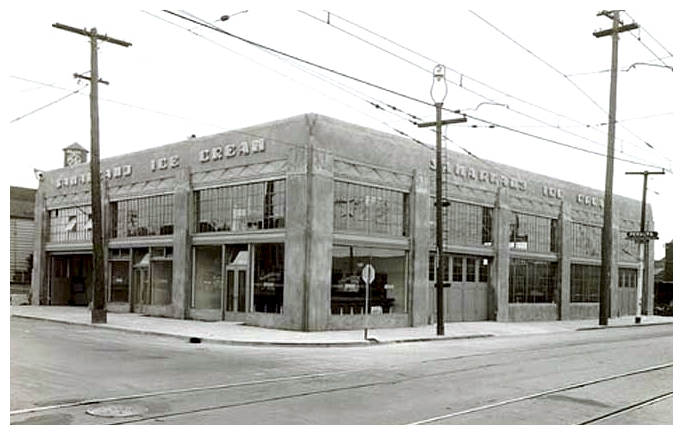
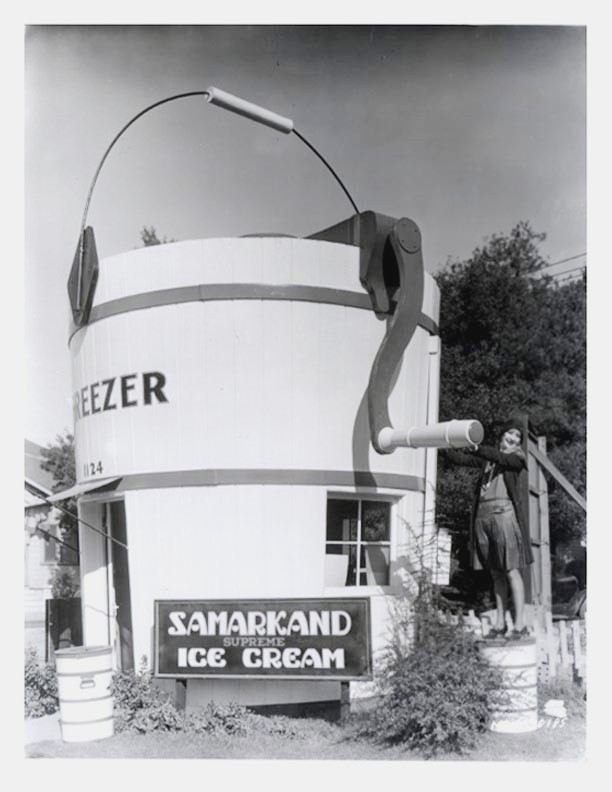
In 1923, JP moved into the production of another food product with the establishment of the Samarkand Ice Cream Company (photo). His head office was at 893 Folsom St., San Francisco, and he built an additional plant in Los Angeles. The ice cream was marketed throughout the State, and here's a photo of an outlet in South Pasadena. These folk art, or roadside attractions, were popular in the 20s and 30s.
By 1929, the Schmidt family was no longer involved with brewing in San Francisco. JP had resigned as president and liquidated his financial interest in the California Brewing Association in 1924, and in 1929 the family closed the the California Bottling Assn. and sold the Sansome St. plant to Merchants' Ice & Cold Storage. Four years later Merchants' would lease the plant to the newly established Globe Brewing Co.
However, Rettenmayer was not through with the brewing industry.
He, along with Paul L. Schmidt - Leopold's nephew and ex-president of the Salem
Brewery Association - made plans to start a new brewery in Oakland. The
following is from the 18 June '33 issue of the Oakland Tribune: "Big Brewery Planned Here - - Plans for the construction of an
Oakland brewery at a cost of $275,000 were disclosed yesterday by the recently
organized Samarkand Brewing Company, with headquarters at 893 Folsom Street,
San Francisco. The proposed plant, it was learned, will have an output of
100,000 barrels of beer annually and will provide employment for a large
number of workers. Details as to the location and date when work will start
have not been settled. A firm of San Francisco architects has been
commissioned to prepare plans. Directors of the brewing company are: J. P.
Rettenmayer, Paul L. Schmidt, Frank M. Kenny, Lee M. Olds, Phillip H. Hess, L.
A. Enge, and Walter K. Olds. Rettenmayer is president and general manager
which operates a plant at the Folsom Street address."

Apparently the necessary capital could not be raised for the Samarkand Brewing Co. and like the Tunison Motor Co., the ventured was cancelled.
But JP was still not through with the brewing business. In
November, 1934, he was contacted by his supervisor from his first job with the
Minneapolis Brewing Co., Armin L. Neubert, who needed help with his
Salinas Brewing and Ice Company. On December 1, 1934, JP was hired as
general manager of the brewery and immediately began making need changes. The
following October, Armin retired and JP, along with some other shareholders,
purchased Armand's interest in the brewery. At that time JP succeeded his old
boss as president of Salinas Brewing & Ice.
Rettenmayer's imprint can be seen with the introduction of their "Remar Beer."
What at first seems odd - to name a beer after a popular brand of bread -
probably appeared quite logical to the pair of German brewers. In the old
country they consider beer equivalent to "liquid bread" - and there was just
such a product produced in the U.S. prior to Prohibition. However, the brewery
also produced brands with local connotations, such as "Rodeo Beer" and "Cypress
Beer," plus their primary brands - "Monterey Beer" and "Monterey Ale."
But JP continued to dabble in other endeavors. On 8 February of 1936 a news story reported that the Samarkand Ice Cream Company had been sold, and that the proceeds were to be used to purchase a winery in Monterey County - possibly the La Colma Wine Co. However, there's no indication that those plans were ever realized.
While it appears that JP was working hard for the Neubert family brewery, there was frustration with the ongoing poor performance of the company, and on 31 December, 1936, a resolution was submitted and approved by the Board of Directors, terminating JP's seven year contract with Salinas Brewing & Ice. At a Director's meeting on 18 January, 1937, the Board agreed to look into the management issue, as well as their nearly zero bank balance.
As far as the public was concerned, JP was still president and manager of the Salinas Brewing & Ice Company at the time of his untimely death on 24 February, 1937. He was found below a second story window of the Santa Lucia Inn, ½ mile north of Salinas on the Coast Hwy. A Neubert family member recalls that JP took the firing very hard, and contrary to published reports, JP's death was actually a suicide. The coroner's report indicated no heart problems, but as was usual for the time, his death was ruled an accident in deference to the family.
A San Francisco newspaper ran this story on 25 February:
"The body of J.P. Rettenmayer, 56, prominent San Francisco
financier and clubman, was returned here from Salinas today. It was found
yesterday on the lawn of a Salinas inn. Doctors said Rettenmayer apparently
had gone to the window of his room for air, following a heart attack, and
had fallen, suffering a second attack. Rettenmayer was founder of the
Samarkand Ice Cream Co., president of the Salinas Brewing and Ice Co., and a
member of the Commonwealth, Rotary and Olympic clubs in San Francisco."
Jacob Paul Rettenmayer was certainly an imposing figure in the business world of San Francisco in the '20s and '30s. I believe that much of his success was due to his business ethic acquired at Sheldon's school in Chicago. This was a school of salesmanship based on the idea that successful business depended upon rendering a service, and that no transaction was justified unless all parties concerned were to benefit. Dr. Arthur F. Sheldon was a pioneer of the Rotary Club, and coined the phrase "He Profits Most Who Serves Best." JP Rettenmayer certainly profited, and it's no coincidence that he was one of San Francisco's earliest Rotarians

Late photo of JP