

PLANNING & PRE-CONSTRUCTION

Situated on Bellingham Bay, the mill town made an excellent distribution hub. It had, not only a fine seaport with the largest and most perfect landlocked harbor on the Pacific Coast, 25miles nearer the ocean and l00 miles nearer Alaska than any Puget Sound rival, but was also served by the Bellingham Bay & British Columbia Railroad. Plus, the BB & BC connected with a terminus of three transcontinental railroads: the Great Northern, the Northern Pacific, and the Canadian Pacific railways. This water & rail distribution advantage was reflected in the 3-B trade mark (above) - reg. 31 Sept. 1902. Schmidt stated that the plant will be employed almost entirely in supplying the growing foreign trade in export lager beer from the Pacific Coast.
The story of the Bellingham Bay Brewery would be incomplete without the mention of Henry Schupp. Henry emigrated from Germany in 1882, and arrived in Montana Territory in 1889, there befriending Leopold Schmidt. The two friends soon formed a partnership and established the Merchants Hotel. While Henry was at Basin, he and Leopold, then living in Butte, formed another partnership to drill an artesian well and build a waterworks system at Basin. When Leopold moved to Washington Territory to build his new brewery in 1895, Henry joined him the following year. He became secretary/treasurer of newly established Capital Brewing Company, and when plans were made to build a new branch plant in Whatcom (to become Bellingham in 1904) Leopold chose his most trusted associate to be the on site representative. The 1901 Whatcom City Directory lists Henry Schupp, manager of the Capital Brewing Co. Depot at Ohio & N. Elk (site of the new brewery). See obit of H.H. Schupp
Schupp was receiving constant instructions
from Tumwater during these planning stages in 1901. In February plans were
laid for a cold storage building to the east of the railroad tracks, and for
a rail head to deliver mill goods to the construction site. A local
newspaper, the Daily Reveille, announced:
"It is reported that a brewery will be erected in New Whatcom, Wash., at
a cost of about $70,000, by the Capital Brewing Co., a site for that
purpose having already been secure."
On the 5th of
March the contract was let for ½ million bricks, and on the 31st of March
instructions were issued to commence building the Ice Factory & Cold Storage
facility. The plan was for the 83' X 45' structure to be finished as soon as
possible, as machinery was arriving from Chicago and Schmidt wanted to be
able to freeze by 15 June. The brewery was to be constructed adjacent to the
Ice plant. The Ice plant project apparently stayed on schedule. The 1902
City Directory carried an ad on the back cover stating:
"For Pure Beer, For Pure Ice, call the Olympia Brewing Company,
telephone Main 31....No. Elk & Ohio."
Elk St. was later changed to Ellis St.
CONSTRUCTION
Actual construction of the Bellingham Bay Brewery began on January 10, 1902,
but this was not the first brewery to bear the 3-B name. While not
affiliated with Schmidt's future brewery, a "Bellingham Bay Brewery &
Saloon" was est. in 1885 by Jacob Beck. The source for his brewery's water
was Chinook Creek, and it's probable that it was a water quality issue that
terminated production of his 5¢ a glass "Whatcom Beer" for after only one
year he closed his brewery. He later built the landmark Beck's Theater at a
cost of $155,000, then the largest and finest opera house in the West,
seating 2,200.
The brewery is located on North Elk street; it is an imposing five-story
structure, with a frontage of 182 feet, 85 feet high and 84 feet deep, a
brick smokestack 100 feet high, fourteen feet in diameter at its base
and seven feet on top. The structure is built entirely of stone, brick
and iron with concrete and asphalt floors and may be classed among the
few fireproof buildings in Washington. It required in its construction
one million bricks, forty carloads of stone, ten carloads of cement and
eight carloads of structural iron, besides the lime, sand, concrete,
stone, etc.
In 1902 Whatcom, the quality of brewing water was still as much an issue for
Schmidt's 3-B as it was for Beck in 1885. The town used Lake Whatcom for its
primary water source. "It's the Water" was not only an Olympia Beer slogan
(adopted that year), it was also Schmidt's guiding principle. This lake
water was rejected as lacking in purity. Instead the 3-B drilled private
wells and established a waterworks on its property
"at an expenditure of $8,000"
according to a newspaper account. As construction neared completion a local
newspaper detailed the project. The following is from the Daily Reveille
of November 28, 1902:
"Bellingham Bay Brewery to Commence Operations - The big Bellingham Bay
Brewery is completed. The machinery has all been installed and tested
and is now ready for operation. The first brew will be made next Monday
or Tuesday. The Bellingham Bay Brewery is the finest brewery west of
Chicago and the equal of any in the United States. There are many
breweries in the United States as large and some larger than this one,
but none with such a combination of modern machinery and appliances. All
the latest and most modern appliances known to the manufacturers of beer
have been installed in this magnificent plant without regard to cost.
When completed it will have cost from $250,000 to $300,000.
 The
structure was built after the plans and specifications made by the well
known brewery architect, Richard Griesser, of Chicago, and the
construction was superintended by Robt. Weismann, of the same city, who
has been busily engaged ever since the 10th of January in pushing this
work to completion.
The
structure was built after the plans and specifications made by the well
known brewery architect, Richard Griesser, of Chicago, and the
construction was superintended by Robt. Weismann, of the same city, who
has been busily engaged ever since the 10th of January in pushing this
work to completion.
 This
brewery has many unique features, chief among them which is its
equipment. The brewhouse
This
brewery has many unique features, chief among them which is its
equipment. The brewhouse
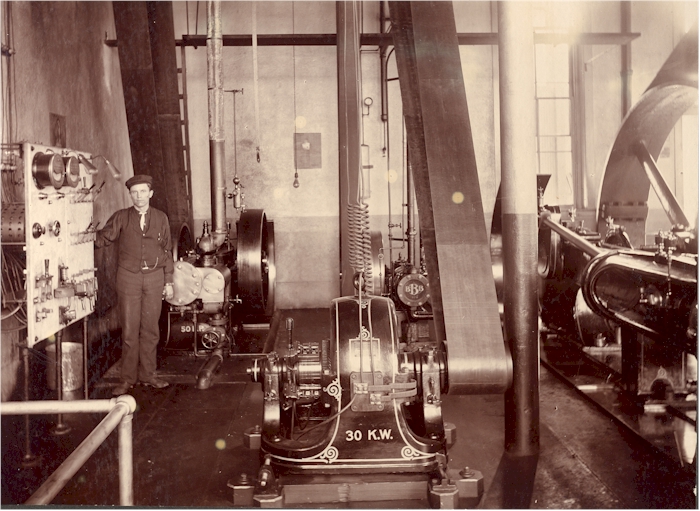 The
most prominent features in this machine room
(left) are a 150 horsepower Corlise
engine and two forty- ton ice machines, furnished by the Vitter
Manufacturing Company of Milwaukee, Wisconsin. There is a 65 horsepower
Ide high-speed engine, one 300 volt dynamo, various large power
The
most prominent features in this machine room
(left) are a 150 horsepower Corlise
engine and two forty- ton ice machines, furnished by the Vitter
Manufacturing Company of Milwaukee, Wisconsin. There is a 65 horsepower
Ide high-speed engine, one 300 volt dynamo, various large power pumps, a Gardner Air compressor, and a complete carbonic gas-collecting
plant and compressor. The wash house (right) and racking room are
furnished with the most modern and improved labor-saving devices so far
invented for the use of breweries.
pumps, a Gardner Air compressor, and a complete carbonic gas-collecting
plant and compressor. The wash house (right) and racking room are
furnished with the most modern and improved labor-saving devices so far
invented for the use of breweries.This plant will have the capacity or rather yearly output of 50,000 barrels of beer. To Mr. Leopold F. Schmidt, president of the Olympia Brewing Company, Olympia, belongs the credit of selecting Whatcom for this great enterprise, he having long ago recognized the advantages and great future of Whatcom and Whatcom County. Mr. Schmidt is well known for his great business ability and boundless energy, upright, straight and strict in his dealings and has the esteem of all his fellow citizens and there will be no question but that he will make as grand a success of this new plant as he did out of the now famous Olympia brewery.
F. L. Fitch, who has been connected with the Schneible Company for the
past fifteen years, superintended the installing of the Schneible
machinery. In speaking of that system of brewing to a Reveille reporter
yesterday Mr. Fitch said:
 "We
claim to make a beer freer from any foreign matter by the Schneible
system than can be made by any other system known to the manufacturers
of beer. While the beer is being manufactured under this system it never
comes in contact with the atmosphere and is consequently free from
microbes and all foreign substances which naturally exist in beer that
is exposed to the atmosphere while being manufactured. All the air that
is used is sterilized and filtered besides. The beer manufactured by
this system contains no fermented substance when it goes on the market,
unlike beer made under any of the old systems. In one of the filters
alone there are forty sheets of ducking through the beer passes under
pressure while hot. The finished beer is filtered under a very low
temperature. This operation is also carried on under heavy pressure."
"We
claim to make a beer freer from any foreign matter by the Schneible
system than can be made by any other system known to the manufacturers
of beer. While the beer is being manufactured under this system it never
comes in contact with the atmosphere and is consequently free from
microbes and all foreign substances which naturally exist in beer that
is exposed to the atmosphere while being manufactured. All the air that
is used is sterilized and filtered besides. The beer manufactured by
this system contains no fermented substance when it goes on the market,
unlike beer made under any of the old systems. In one of the filters
alone there are forty sheets of ducking through the beer passes under
pressure while hot. The finished beer is filtered under a very low
temperature. This operation is also carried on under heavy pressure."
The Bellingham Bay Brewery Company occupies nearly an entire block of ground with its brewery, storehouses and ice plant. It is admirably situated on the B.B. & B.C. railroad and has a side track of its own to which cars from any of the roads may be switched.
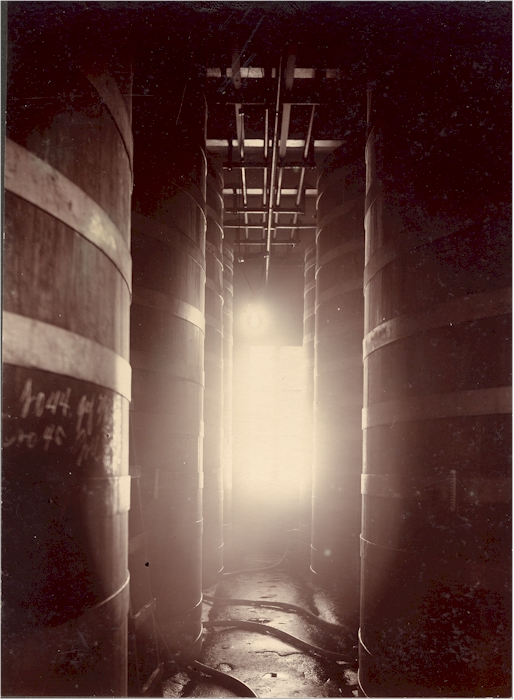 The cellar of the brewery has a storage
capacity of 50,000 barrels (left) and by using the brew-house
100,000 barrels of beer can be stored in the establishment at one
time. Six carloads of malt have already arrived and there are five
more cars on the road.
The cellar of the brewery has a storage
capacity of 50,000 barrels (left) and by using the brew-house
100,000 barrels of beer can be stored in the establishment at one
time. Six carloads of malt have already arrived and there are five
more cars on the road.
An addition to the new ice plant (right), that was erected a year ago, will be enlarged to almost treble its present capacity, which will be about twenty tons of ice daily."
 Through
November and December of 1902 local newspaper ads proclaimed:
Through
November and December of 1902 local newspaper ads proclaimed:
The brewery's first label (below) depicted three honey bees as an obvious play on the 3-B brand name. When registered the company stated that the trade mark had been in use since 31 Dec. 1902. Also the label uses Whatcom instead of Bellingham, which became the city's name on October 1904. When Whatcom was removed from the label, so were the "three bees" and they were no longer a part of the brewery's trade mark.

"3-Bee label" c.1903 - author's collection
COMPETITION & PROMOTION
With the brewery on-line 3-B now had to secure the local market, as well as
a west coast market, to utilize its capacity and maximize profits. The only
local competition was from the Whatcom Brewing &
Malting Co., and "imports" from Seattle and Tacoma. Founded in 1899 by
Fritz Grathwohl, and after an unprofitable two and a half years, he sold out
to a group of Bellingham businessmen for $20,000. This group was comprised
of the brewery's superintendent and local saloon owners - and it appears
that Leopold Schmidt was behind this takeover.
The new management
invested in improvements and initiated an aggressive advertising campaign.
It was now at full capacity and enjoying an increased demand for its
product.
The 3-B had been in operation a mere two weeks
when Schmidt completed his planned takeover. On 13 January of 1903, after
only nine months, the revitalized brewery was absorbed by 3-B for $50,000. A
number of the saloon owners took stock in 3-B for part of their holdings,
and all ten saloons were now "tied-houses."
Dealing with the
"imports" required a different strategy. With the hometown advantage, 3-B
made its presence known in the town's many saloons through intensive
promotions and "sweetheart" deals to pour 3-B Beer to the exclusion of all
others. Thus established brands like Rainier Beer from
Seattle Brewing & Malting, and Pacific Beer from Tacoma's
Pacific Brewing & Malting, saw their market share dwindle.
Saloons were also important in
introducing the 3-B Beer to Fairhaven & Whatcom - soon to become Bellingham.

 Tokens for a free
glass of 3-B Beer, and a tin bar spinner (right) are examples of
promotional items given to saloon patrons.
Nor could these "imports" from Seattle & Tacoma compete with 3-B's free home
delivery. Fairhaven's Evening Herald of July 6, 1903 announced:
Tokens for a free
glass of 3-B Beer, and a tin bar spinner (right) are examples of
promotional items given to saloon patrons.
Nor could these "imports" from Seattle & Tacoma compete with 3-B's free home
delivery. Fairhaven's Evening Herald of July 6, 1903 announced: "Two dozen ½ pint bottles of 3-B Beer - Delivered to your home for $1.00 - Just think of it, it's cheaper than city water. Try a case."
The half-pint bottle (above right) reads
"Whatcom" instead of "Bellingham," so these bottles were made
prior to the town's name change in October, 1904 - and were probably the
same bottles mentioned in the 1903 announcement above. With the change in
the city's name it would be expected that new bottles would have been
ordered to reflect the change, but no such bottles have been found. The Brewery did however, change "Whatcom" to "Bellingham" when they
replaced the original crates (above left).
The cases of beer were delivered by a
fleet of horse drawn wagons, in
the same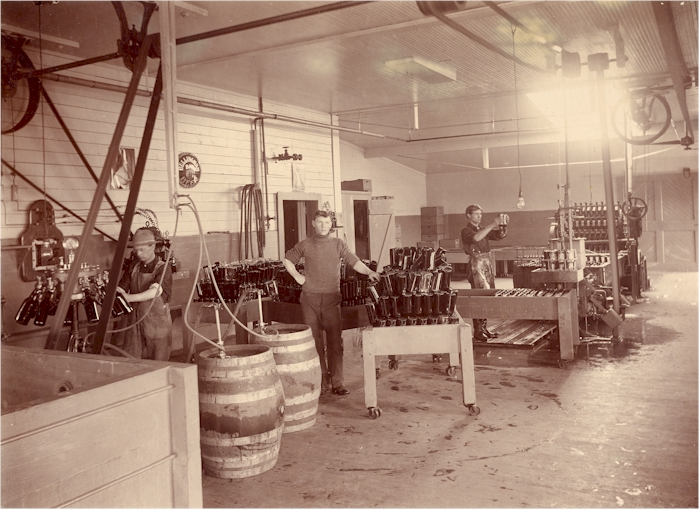
 manner
that the milkman delivered his wares. All of the beer
bottled at the brewery was bottled with "modern" crown closures. The bottles
were un-embossed, clear or amber colored glass, which then had paper labels
affixed (left). The brewery's Bottling House (right) shows
quart bottles being filled.
manner
that the milkman delivered his wares. All of the beer
bottled at the brewery was bottled with "modern" crown closures. The bottles
were un-embossed, clear or amber colored glass, which then had paper labels
affixed (left). The brewery's Bottling House (right) shows
quart bottles being filled.

Bellingham Bay Brewery show wagon, c.1905
The breweries used any method to promote their product, and what better
vehicle than a parade wagon? They also entered displays of their goods at
fairs and expos. This display was no doubt photographed because it won a
medal (for best brewery
 display)
at the 1905 Lewis & Clark Exposition in Portland. It showed many of the
promotional items from the Brewery, including signs, bottles, trays,
glasses, foam scrapers, bottle openers, and labels.
display)
at the 1905 Lewis & Clark Exposition in Portland. It showed many of the
promotional items from the Brewery, including signs, bottles, trays,
glasses, foam scrapers, bottle openers, and labels.
Among the
bottles on top, are the ½ pint, embossed bottles which shows that they were
not distributed with a label on the reverse, a point that had been the
subject of conjecture.

A close-up of the interior of the display shows a reverse-painted-on-glass,
convex sign flanked by two smaller glass signs. Below that are two barrel
ends with large barrel labels. The taller, quart bottles in front are topped
with what appears to be loop pulls, but are actually wire cap lifters, or
bottle openers.
 A
nice promotional item was this nickel coated, "clam shell" match safe from
1903 . The match was removed by gripping it in the cutout and
A
nice promotional item was this nickel coated, "clam shell" match safe from
1903 . The match was removed by gripping it in the cutout and lifting the spring loaded lid enough to free it. There are grooved end
plates for striking the match.
lifting the spring loaded lid enough to free it. There are grooved end
plates for striking the match.
Another popular item was the watch
fob. It's made of brass with a gold wash. On the reverse is embossed:
"Compliments of Bellingham Bay Brewery, Inc. Bellingham, Wash."
 Another way to promote the brand was to own a baseball team. The traditional
link between beer and baseball is usually attributed to Colonel Jacob
Ruppert, who bought the New York Yankees in 1915. However, it appears that Leopold
Schmidt was just as innovative. He sponsored the Bellingham Yankees ten
years before Ruppert got his Yankees.
Schmidt's team was part of the
Northwest league, but only competed in '05.
While his Bellingham Yankees never produced the likes of the class-A Bellingham
Mariners', Ken Griffey, Jr., it was still a local hit.
Another way to promote the brand was to own a baseball team. The traditional
link between beer and baseball is usually attributed to Colonel Jacob
Ruppert, who bought the New York Yankees in 1915. However, it appears that Leopold
Schmidt was just as innovative. He sponsored the Bellingham Yankees ten
years before Ruppert got his Yankees.
Schmidt's team was part of the
Northwest league, but only competed in '05.
While his Bellingham Yankees never produced the likes of the class-A Bellingham
Mariners', Ken Griffey, Jr., it was still a local hit.
The most widespread method used by breweries to promote their brand of beer
was to place their name on various items utilized by the primary
purveyors - the saloons. The most obvious was the outdoor signs many of
which were quite decorative. Most were "reverse-painted-on glass" or
porcelain, and are highly prized by collectors.
 Another desirable item used
to promote the brewery was the beer stein. 3-B had an especially nice
example which, due to the cost of manufacture, must have only been given to
special accounts or share holders. Schmidt apparently contracted with the
same German manufacturer to make steins for all three of his breweries.
The steins for the Olympia, Salem, and Bellingham breweries are identical,
and came out at the same time, in 1904. This set of three can be seen on the
Olympia Brewing Company page.
Another desirable item used
to promote the brewery was the beer stein. 3-B had an especially nice
example which, due to the cost of manufacture, must have only been given to
special accounts or share holders. Schmidt apparently contracted with the
same German manufacturer to make steins for all three of his breweries.
The steins for the Olympia, Salem, and Bellingham breweries are identical,
and came out at the same time, in 1904. This set of three can be seen on the
Olympia Brewing Company page.
Other steins were used as enticements, most of which depicted monks in various activities - usually related to the consumption of food or drink. There were sets of six mugs with a tall pitcher, that came in brown, green or a blue-gray. These sets were imported from France and were manufactured by the Lebeau Porcelain Co. The first sets were given away in June, 1906.
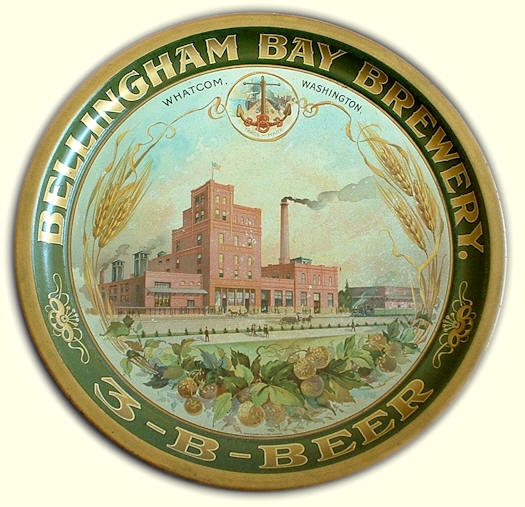
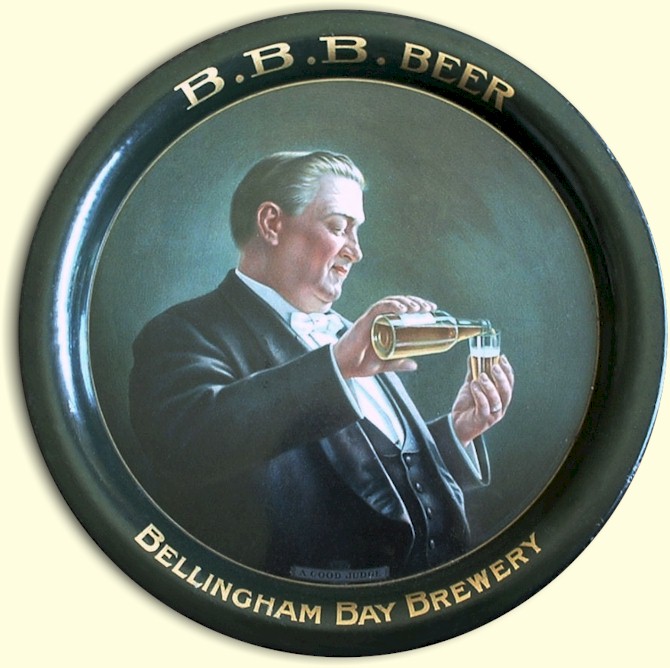 Another common advertising item was the beer tray. 3-B ordered its
first tray, an original graphic depicting the factory, from
Chas. W. Shonk of Chicago, IL. The rest of its trays were "stock trays"
which meant that they were not unique to
3-B, and the images were used by other breweries.
Another common advertising item was the beer tray. 3-B ordered its
first tray, an original graphic depicting the factory, from
Chas. W. Shonk of Chicago, IL. The rest of its trays were "stock trays"
which meant that they were not unique to
3-B, and the images were used by other breweries..jpg) This practice precluded
the expensive of commissioning original art work. The brewery appears to
have purchased these stock trays exclusively from the Meek Co. (1901-1909)
of Coshoncton, OH. When Jasper Meek retired, the firm remained in business
as the American Art Works, and supplied 3-B with the "Old Heidelberg" trays
from 1910 to 1914.
This practice precluded
the expensive of commissioning original art work. The brewery appears to
have purchased these stock trays exclusively from the Meek Co. (1901-1909)
of Coshoncton, OH. When Jasper Meek retired, the firm remained in business
as the American Art Works, and supplied 3-B with the "Old Heidelberg" trays
from 1910 to 1914.
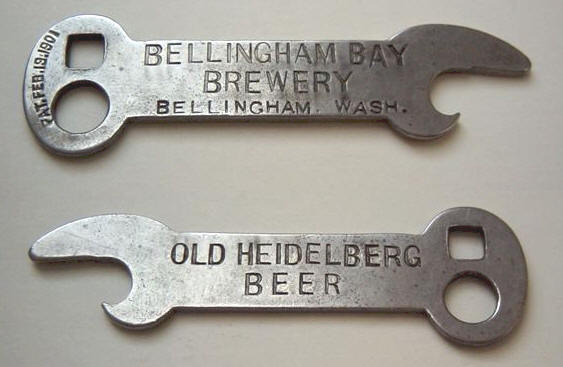 Cap
lifter or "church key" ca.1910. It was meant to be placed on a key chain and
had the additional feature of a Prest-O-Lite key. This square hole served as
a wrench to open the valve on carbide tanks located on the running boards of
early autos. When the valve was opened, it supplied gas for the headlights.
Cap
lifter or "church key" ca.1910. It was meant to be placed on a key chain and
had the additional feature of a Prest-O-Lite key. This square hole served as
a wrench to open the valve on carbide tanks located on the running boards of
early autos. When the valve was opened, it supplied gas for the headlights.
An unusual piece, and one that is unique, is a hand painted display plate
depicting the brewery in high relief. These were given away
with the purchase of a case of beer in December of 1904 and 1905. The
brewery referred to them as "Austrian plaques." Each was hand painted and
vary greatly in appearance.
the brewery in high relief. These were given away
with the purchase of a case of beer in December of 1904 and 1905. The
brewery referred to them as "Austrian plaques." Each was hand painted and
vary greatly in appearance.

The beer glass is another item that
could effectively promote the brewery's product. There are three major
variations versions of etched glasses depicting the 3-B factory: one has
"Whatcom, WA" (1903-04), and another shown here, has "Bellingham, WA" (1904-10).
The third has the brand "Old Heidelberg" (1910-15), which can be seen further below under the topic heading -
"New Ownership."

 A Brewery photo of the 3-B office with Henry Schupp at
work (seated at roll-top desk), also gives a glimpse of some of the
advertising pieces on the wall. A close-up shows two calendars and some
items from the parent, Olympia Brewing Company.
A Brewery photo of the 3-B office with Henry Schupp at
work (seated at roll-top desk), also gives a glimpse of some of the
advertising pieces on the wall. A close-up shows two calendars and some
items from the parent, Olympia Brewing Company.  Calendars were another
effective way to keep the Brewery's name in the public's eye through out
the year. Unfortunately, due to the limited usefulness of these items,
few have survived. An exception is this 1906 calendar (left) from
the author's collection.
Calendars were another
effective way to keep the Brewery's name in the public's eye through out
the year. Unfortunately, due to the limited usefulness of these items,
few have survived. An exception is this 1906 calendar (left) from
the author's collection.

 foam scraper made by the Meek Co.
 foam scraper by Whitehead & Hoag Co. (same on reverse)
This reverse on glass, convex sign is from the Bryan Anderson collection, and currently is the only one known.
DISTRIBUTION
Like most breweries of the
period, the Bellingham Bay Brewery served a largely local
market. But 3-B also shipped its "Pale Export" to major markets
on the Pacific coast, Alaska, as well as Canada. The Alaska
market even had its own brand called "Alaska Special Brew"
(see square
tray above).
As early as June of 1903, with only six
months in operation, 3-B was already an established exporter.
The
Daily Reveille reported on the 4th of June that
".
. . the Brewery was shipping 100 barrels every five days to San
Francisco,
a city with 27 breweries."
However, not all of the brewery's output was 3-B Beer. A San
Francisco bottler, John Fauser, contracted for beer that he
bottled under his own label, Phoenix Beer.
Some Pacific Rim countries
were also markets for 3-B Beer. This widespread distribution was
noted in a 3-B ad, placed in a November 1903 program from Beck's
Theater, which quoted these two items:
"THEY ALL WANT IT
-
It seems odd to think of shipping beer all the way to the Yukon, or
the Philippine Island of Luzon, but reflecting on the events of the
day, it makes sense. With the Alaskan gold rush, and our occupation
forces in Manila after the Spanish-American War, there were
obviously marketing opportunities for any brewery set up for long
distance distribution.
With a railhead at the door and a terminus to three railways, 3-B
sought to modernize its delivery by adopting the concept of
refrigerated box cars. The following is from the Daily Reveille
of September 10, 1905: The car was made in Bellingham and is one of the
best refrigerator cars that can anywhere be found. The "box" is
eight and a half feet high and nine feet wide on the inside. The
car is 34 feet long. Its construction cost $1,027.
The sides
are about ten inches thick. Between the outermost and the second
walls is a three-inch space packed with hair. The inner side of
the second wall is lined with paper, and between this and the
next wall, or partition, there lies an air space which is
separated from a second air space by a partition. A fourth
wall made of ceiling* which is shellacked completes the
structure in the sides of the car. The exterior of the
car is painted yellow. "Bellingham Bay Brewery, Bellingham.
Wash.," is lettered on one side of the door. On the other side
"3-B Beer," and "Made in Bellingham." The designs on the side of
the car also include a painting of the brewery's trade mark, the
anchor, ship, wharf and train. The car has a capacity of 40,000
pounds.
"ITS NO WONDER -
That 3-B Beer is increasing in popularity in even such remote
regions as the icy Yukon. It's conceded to be the most
refreshing, pure, health giving beverage on the market. It
is invigorating, strength-giving and the perfection of
malted flavor. Besides its a home product of Bellingham Bay
- the exhilarating 3-B Beer."
- Fairhaven Times
If you should ever go to Wallace, Idaho,
Or over the Klondike
snow to where the ice flows flow,
Or to some ranchero on
Luzon Isle, you know
Or anywhere from Borneo to Southern Californio
Don't be
surprised, old chap to find 3-B on tap - They'll have it,
dontcher know."
To facilitate these overseas shipments; a
refrigerated building was erected on Bellingham Bay. The following
is from
“B.N. Chisholm has the contract for the erection of the B. B.
brewery's cold storage plant on the E street wharf. The company
purchased the site some weeks ago. The building will be at the
point where the railroad spur joins the dock. The dock for the
warehouse will be 30x58 feet, and the building 16x26 feet. The
frame of the building is already up.”
REFRIGERATOR CAR MADE IN BELLINGHAM - The Bellingham Bay Brewery
yesterday morning rolled out from its shops a brand new
refrigerator car and at noon sent it on its maiden trip with a
car load of beer for Cle Elum, where the company owns a large
refrigerator.
The top is built with
a double roof, lined with paper. Joining this is an air space of
paper. Behind the shellacked ceiling is four inches of saw dust
which completes the structure of the roof.
Thorough
provision for, protection has been made at the bottom in the
construction of a double floor. The space between the floors is
packed with a thick layer of charcoal.
* Ceiling
refers to "beaded ceiling" which is also called beaded board or
car siding. We now see these grooved boards used in homes for
wainscoting.
 This 1905 postcard shows two of the refrigerator cars
with the numerals six & seven painted on the sides,
which would suggest that 3-B owned at least seven of
these cars.
This 1905 postcard shows two of the refrigerator cars
with the numerals six & seven painted on the sides,
which would suggest that 3-B owned at least seven of
these cars.
The above article might lead one to believe that the 3-B
manufactured the cars, when in fact their shops merely
painted them and added the 3-B lettering & trade marks.
Whether by rail or ship, 3-B had the ability to sell its beer in the huge San Francisco market, and had done so almost immediately. The beer was shipped to the City and then bottled there. The 1904 SF telephone directory lists the Bellingham Bay Brewery, Inc. at 3109 20th. That was the address of Joseph B. Cuneo, agent for brewery and manager of the 3-B Bottling works. Clearly, Cuneo had the 3-B account in early 1903, since he would have placed his order for the "3-B Beer - Whatcom, Wash." ceramic stoppers prior to November of 1903, when the city's name changed to Bellingham.
The 1905 city directory lists Cuneo as the 3-B agent, but prior to the publication of the next year's directory Cueno had been replaced by Diedrech Meinke and while the 3-B Bottling Works is still at the 20th St. location Meinke is using 60 Dorland St. as his office. He remained 3-B's agent/bottler until 1910.

D. Meinke letterhead June 1906

Ceramic stopper with the monogram of Joseph B. Cuneo, proprietor of the
3-B Bottling Works in San
Francisco, from 1903-1906.

This quart bottle is ca.1903-1906, and vertically
embossed: "BELLINGHAM BAY BREWERY / 3 B
BEER SAN FRANCISCO, CAL." It is considered Rare.
From 1906-1910 the 3-B Bottling Works was under the mgt.
of Diedrich Meinke.

This label was used on embossed blob top bottles
with porcelain stoppers
embossed: "D. MEINKE - SAN FRANCISCO."

"Bellingham Beer" crown top
bottler opener, ca.1908-1910
The patent for this cap lifter was applied for in December 1907, so the earliest it could have been used was in 1908. That's when it was issued by the brewery's San Francisco agent, Diedrich Meinke. In 1910, when the new operators of the Bellingham Bay Brewery decided not to re-instate his contract, Meinke's 3-B agency was closed.
EXPANSION
The 1906 San Francisco earthquake provided unexpected opportunities
for the 3-B, as well as other northwest breweries.
From the
Puget Sound American of August 23, 1906:
"$1,000,000 ORDER FOR BEER - Local Plant Will Be Enlarged to Meet California Demands.
Orders for almost $1,000,000 worth of beer has led the Bellingham Bay Brewery to consider plans for $20,000 worth of improvements in its local plant. The cellar capacity, now about 150 barrels daily, will be doubled and the ice tanks also will be doubled in capacity. A story was recently added to the main building and the other addition will be built on the west side of the structure.
The unusual orders were received in California when Manager Shupp went to San Francisco. The local plant, in common with the Seattle and Portland breweries, has grasped the opportunity presented for trade since the earthquake and these concerns now enjoy the bulk of the business. The British brewery trust, whose plants were destroyed, has determined to re-enter the field to compete with its northern rivals, and it has announced that it will spend $2,000,000 in constructing breweries.”
The brewery's plans for the $20,000 expansion were completed,
doubling its capacity to 100,000 barrels a year.
With the
loss of brewery production in San Francisco, Leopold Schmidt decided
to establish his own brewery in that city. He had purchased three
lots on Sansome St. in 1902 and built a bottling works which handled
his beer that was shipped from the Tumwater plant. So, in late 1906
he decided to build a brewery on the adjacent two lots, and the
Acme Brewing Company became the newest of Schmidt's
breweries. However, he retained the bottling works for his Olympia
Beer, so Acme had to contract with a local bottler to handle their
output. John Fauser's
Phoenix Bottling Works was then chosen to bottle Acme Beer.
Like many bottlers, Fauser marketed his own brand of beer. For his private label, Phoenix Beer, Fauser purchased beer from Leopold Schmidt. However, it wasn't Acme Beer, it was beer produced by the Bellingham Bay Brewery.

OPPOSITION
From the time the Bellingham Bay Brewery commenced production, the business was threatened by the era's crusade against alcoholic beverages. The primary adversaries were the Women's Christian Temperance Union and The Anti-Saloon League, both of which were gaining influence with lawmakers.
The following was taken from a Temperance newspaper published by the Anti-Saloon League:
"What the Brewers Brew....
They brew crime of every sort. Sweep away the breweries and the distilleries, and you will secure municipal reform, banish the most prolific causes of poverty, insanity and crime, and clean the cities of most of their moral rottenness. What a crime the manufacturers and dealers themselves commit by making money out of the bodies and souls of men, and wringing wealth from the dripping blood of broken-hearted women and from the hungry mouths of starving innocent childhood! What a hell broth indeed is this which brews poverty and rags, hunger and cold, crimes dyed in a thousand hues, sickness and death to vast numbers, wrecking both body and soul!"
With over 60 saloons in Bellingham by 1906, there was no shortage of
sensational stories reporting anti-social behavior in these
establishments. In 1907, the state enacted Sunday closing law for
businesses, which was a thinly disguised "lid" - a ban on Sunday
sales of alcohol. As this was most working man's only day off, it
was quite a blow to shut the saloons on the busiest day for beer &
billiards.
In 1909, possibly because of the lid and expected further
opposition in Bellingham, Schmidt purchased the
Port Townsend Brewing Company across Puget Sound on the Olympic
Peninsula. Apparently anti-saloon sentiments were not as strong in Port
Townsend as in Bellingham.
However, later that year the situation grew more
ominous for Washington brewers and saloon owners. The State Legislature passed a
"local option" bill that allowed each municipality to hold a special
election to
completely ban saloon operations within their city limits.
While Bellingham had yet to vote on whether to go "dry" or remain
"wet" the anti-saloon leanings were strong, and a November 8,
1910 election was looming. So Schmidt made some public ultimatums in
hopes of thwarting the prohibitionists.
On January 11, 1910
the Bellingham Herald announced that the 3-B was to be sold,
however finalizing the sale was contingent upon the local option
vote. If the drys win, the recently secured lease, by Andrae &
Stowe, will be declared off and the property returned to Leopold
Schmidt, president, and Henry Schupp, secretary. They "threatened"
that if the City votes dry it is probable the Brewery will close.
They added that they were
".. not inclined to operate their own plant in the City because they
have all they can handle with their other breweries."
Two months later, the Bellingham Herald announced that
Schmidt had purchased the Byron Hotel for $100,000. Schmidt said
that he bought the property outright to avoid the payment of heavy
installments on the lease he had taken out in 1907. Leopold Schmidt
and Henry Schupp had earlier recognized the Temperance threat to
3-B, and laid plans to diversify business operations in Bellingham.
In October 1907, Schmidt had taken
out a 10 year lease on the Bryon Hotel. Now Schmidt and Schupp
announced plans to erect a new hotel on the present site, but they
warned
".. only if the local option does not carry."
Their efforts to effect the election were in vain, and effective January 1, 1911, Bellingham was dry. And it appears that Schmidt's ultimatums were but empty threats. Andrae and Stowe's lease to purchase the brewery was not cancelled, and the Brewery was not closed. Also, in September of 1913 the Bellingham Herald reported that construction of the new Byron Hotel has resumed "on a grand scale."
Upon completion the Byron was renamed the Leopold Hotel and had its Opening on May 24, 1913. The Bellingham Herald proclaimed:
"Leopold Hotel one of the most modern on the Sound."Leopold Schmidt was to enjoy his fine new hotel for exactly one year and four months. He died in his suite at the Hotel on 24 Sept. 1914.
On 7 January, 1910, Leopold Schmidt announced in the
Bellingham Herald that he had leased the brewery and ice
plant to Pierre J. Andrae and Edward L. Stowe.
The lessees also had an option to buy the plants at any time
within a period of five years.
In August of 1911, Stowe changed the brand name from
Original Heidelberg to Old Heidelberg (above right).
He also adjusted the wording on the label.
The "Original" label claims the beer to be "Old Type German
Beer" but the label was changed to say: "A Purely American
Beer." This may have been a response to growing anti-German
sentiments resulting from the increase of German imperialism
in Europe. He also changed the monogram at the top of
the label from A. S. for Andrae & Stowe, to an E. L. S.
monogram for Edward L. Stowe.
Pierre Andrae was an experienced practical
brewer and also well versed in the theoretical and scientific
part of his profession, being a graduate of the Wahl-Henius
Institute in Chicago. During the previous four years he had been
in charge of the brewing operations at the No. Yakima Brewery &
Malting Co.
Despite the
victory of the drys, and due to loopholes in the local option
legislation, the Brewery could remain open. Andrae & Stowe then
began selling the 3-B's output under the brand Original
Heidelberg (below left).


While all the saloons were now closed, one could still
consume alcoholic beverages in their own home, and the
brewery could make home delivery of sealed cases. The
Brewery could also ship its beer outside of the city limits,
and out of State. Since California was still its largest
market the business remained solvent. However, for reasons
unknown, Andrae left the business on April 12, 1911,
after selling his share to Stowe.

The new company
continued to use beer trays and etched glasses as
promotional items for the Brewery, with "Old Heidelberg"
replacing "3-B" or "Bellingham Bay Brewery."


 The trays shown
here were all stock trays
manufactured by American Art Works, of Coshoncton, OH,
successor to the Meek Co. Many other breweries have used
thes images on their trays.
The trays shown
here were all stock trays
manufactured by American Art Works, of Coshoncton, OH,
successor to the Meek Co. Many other breweries have used
thes images on their trays.
From left to right: "Join Me"
c.1909; Mildred" c.1910; "The Invitation" c.1911; and "Good
Morning" c.1913.
While able to survive under the sanctions of the "local option," the Brewery was about to be dealt a fatal blow.
PROHIBITION
In 1910 women had been granted the right to vote, and the Woman's Christian Temperance Union was still at work. So it's no surprise that on November 3, 1914, Washington State citizens voted to prohibit the manufacture and sale of alcohol, including beer. Shortly before the Statewide Prohibition vote, Leopold Schmidt passed away. He spent his last days at his Leopold Hotel in Bellingham, dying on September 24, 1914, without having to witness the destruction of his brewery business.
Prohibition was to take effect on January 1, 1916. Stowe immediately announced plans to sell his remaining stock and pack up the brewery's equipment for San Francisco, however Stowe's plans were set aside and his brewing days were over.
Then, on 28 May 1916, the brewery was sold to an Olympia group with plans to utilize 3-B's remaining equipment to make fruit drinks. The plant was to operate as a branch of the Schmidt family's Northwest Fruit Products Company and the three ex-breweries were depicted on the company's letterhead. The Salem plant was already making a Loganberry product called Loju and the Olympia plant a sparkling apple champagne called Applju.

CONVERSION & DEMOLITION
The plans for manufacturing fruit juice did not materialize, but the
Bellingham Ice Company continued under the management of Reither and
the Langs.
On March 19, 1917, stockholders of the Bellingham Bay Brewery met
for the final time and unanimously opted for dissolving the
corporation.
In July, 1918,
The Royal Dairy continued to lease the ice plant to
the Bellingham Ice Co., but now it was marketed under the Royal
Dairy's brand, Crystal Ice.
The Whatcom County Dairyman's Association and Darigold used the
building from 1927 to 1967. After Darigold moved out, the old
brewery would remain vacant until being torn down on February 8,
1970.

REPEAL
While no attempt was made to re-open the Bellingham Bay Brewery when Prohibition was repealed in April, 1933, there were two attempts to establish a new brewery in Bellingham.
The Sept. 5, 1933 issue of the
Seattle Daily Times reported: "Bellingham---Construction
of Bellingham's new brewery with a capacity of 15,000 barrels a
year, begins today, W. W. Fairburn, president of the
Whatcom-Skagit Brewing Company, the builders, announced.
Manufacture of Spring-Water Brew will begin about November 1st."
Property was leased from the Port of Bellingham and a structure was built for the brewery. However, due to under capitalization the brewery never reached production and the enterprise was canceled in 1934.
The next attempt to open a
brewery came two years later. The February, 1936, issue of Western
Brewer reported that Ed Stowe has organized a company to operate
a brewery on a site acquired in the Eldridge Industrial District.
Again, the project never reached the production phase, but not for
lack of brewing expertise. This was the same Ed Stowe who had
operated the Bellingham Bay Brewery from 1910-1915.
The Eldridge Industrial site chosen by Stowe, was located at 2925 Roeder Ave., and was the same structure built for the proposed Whatcom-Skagit Brewing Co. As late as 1949, the Port of Bellingham still referred to it as the "brewery building."
Article by
Gary Flynn

3-B COLLECTIBLES - For
Sale


WARNING
 Fake 3-B match safe
taken from header at top of page
Fake 3-B match safe
taken from header at top of page
ACKNOWLEDGEMENTS
Thanks to the late Isabel Stowe, widow of Edward R. Stowe, Jr., for providing artifacts from the Bellingham Bay Brewery. Edward L. Stowe, Sr. was the last proprietor of 3-B.
To Steve Stimson, for allowing me to use his family's photos of the interior of the brewery, and for the great "finger" saloon spinner. Steve's mother was the niece of Henry Schupp, who managed the Brewery from 1901 to 1910.
To collectors: John Rauch, and Jim Doidge, for allowing me to copy images and photograph their 3-B artifacts.
To Jeff Jewell, photo historian for the Whatcom Museum of History & Art, for graciously sharing his historical research and images from the photo archives.
To John Cartwright for the image of the cap lifter.
To Dr. Thomas Jacobs for the images of the 3-B labels on the embossed quart bottles, and for data on the SF bottlers, Meinke & Cuneo.
To Bryan Anderson for the Original Heidelberg label.
To Mike Magnussen for the "Monk" mug.
To Ben Strom for the Old
Heidelberg label, the parade wagon photo, and the photo of brewery
from the 1960s. For any comments, additions, or corrections - or for 3-B items you wish
to sell -
All contents including images are copyright by BreweryGems.com
please
and can not be used without permission from Brewery Gems.
Copyright © 2004 ~ All Rights Reserved.



