BREWERY GEMS PROFILES:
Gustav Hodel - Brewer


BIOGRAPHY of GUSTAV HODEL
(1875 -1966)
The following draws heavily on a biography
written by Gus Hodel's grandson, William "Bill" Whetton.
In 1882, Gustav's oldest sister, Karolina, married a local brewer named
Martin Blum. Later that year, Martin's older brother, Andrew, who
had emigrated nine years prior, encouraged Martin and his new wife, to
join him in America. Andrew was a maltster with the Metz Bros.
Brewing Co. in Omaha, and found Martin a position at another Omaha
plant, Storz & Iler's Columbia Brewery - later to become the Storz
Brewing Co.
By
1887 Martin had become a successful brewmaster at the Omaha plant.
However, he wanted his own brewery so he partnered with C. Hameister and
together they purchased controlling interest in the Yankton City Brewery
of Yankton, South Dakota, 130 miles NW of Omaha. Martin remained there
less than two years, selling out in 1889, and moving to Galena, Ill. to
establish a brewery¹
there.
While Martin was building his new brewery, Karolina wrote to her
youngest brother, Gustav, and invited him to join them in Galena. She
included $60 for his fare. Martin was incensed at this until it was
agreed that Gustav would work in the brewery for three months to pay
back the debt. On his arrival, he was not well received by his
brother-in-law and was put to work immediately to work off the $60 debt.
He was only 14 when he arrived, so rather than leave when his debt was
repaid, he stayed on in spite of the harsh working conditions he had to
endure. By 1892, he had managed to save $100. He was only 17, but he was
now ready to leave Galena. To
quote his grandson: "His childhood had been
extreme and later in his life he would not accept less than he had
done from those around him. His exterior had grown callus, but
within him he was not a cruel man in spite of his experience with
Martin Blum."
Gustav traveled to Omaha, and went to the Metz
Bros. Brewing Co. where Andrew Blum had been a maltster, and took a
position that paid $60 a month. This was more than average, and the
hours were not too long. But he was young and restless, and wanted to
travel, so he in early 1893 he left Omaha for St. Louis. There he found
a position with Charles G. Stifel's Brewery, but was paid $8 less per
month than he'd received at his previous position with the Metz Brewery.
He stayed only three months, having been tempted to travel to Chicago
for the World's Fair. He enjoyed the excitement of the fair, but was
soon out of money and unable to find work.
"Gustav had gone far, from
working for Martin Blum for $20 a month, to his new job of $250 per
month - including the large and completely furnished brewmaster's
house. He had seen much of the United States and had a position of a
professional brewmaster. He was no longer a "green-horn" who had
difficulty with the English language nor was he to be taken in by
low wages or poor accommodations. In his new prosperity he decided
to put an end to his visits to the "red light" district of Butte and
marry and have children. So, he courted Mary Weidenfeller in the old
world tradition of flowers and Sunday carriage rides, and they were
married on February 11, 1903."
After more than three years of marriage, the
Hodels still had no children. It was suggested that Mary see a doctor
for treatment. However, the doctor may have been a "quack" since the
treatment proved fatal for Mary. She contracted blood poisoning and died
on September 12, 1906.
Their Old Fashion Lager³
sold moderately well, but they had a serious competitor from another
major brewery. Fritz Sick and his son, Emil, operated the huge
Lethbridge Brewing & Malting Company, and while it was 100 miles from
Medicine Hat, its products dominated the region. So, in June of 1927,
after only three years of operation, and lack-luster sales, their
Medicine Hat Brewery closed. He and his family remained at the Star
Brewery until Repeal in 1933, when he returned to Montana to work for
his old competitors, Fritz and
Emil Sick.
Gus was to become the first brewmaster at their Great Falls Brewery.
In January of 1936, the company was re-organized as Lewistown Brewery,
Inc., but it was not to last. In 1938, a mere two years later, the
company found that it could no longer compete with the larger breweries,
and the Brewer's Union in Great Falls demanded that the brewery increase
its wages paid to employees, which it simply could not afford. The
situation left the company with no option but to let their employees go
and close down the brewery.
FOOTNOTES:
¹
²
Harry Clinton Yuill was an successful industrialist whose name was
synonymous with Medicine Hat. 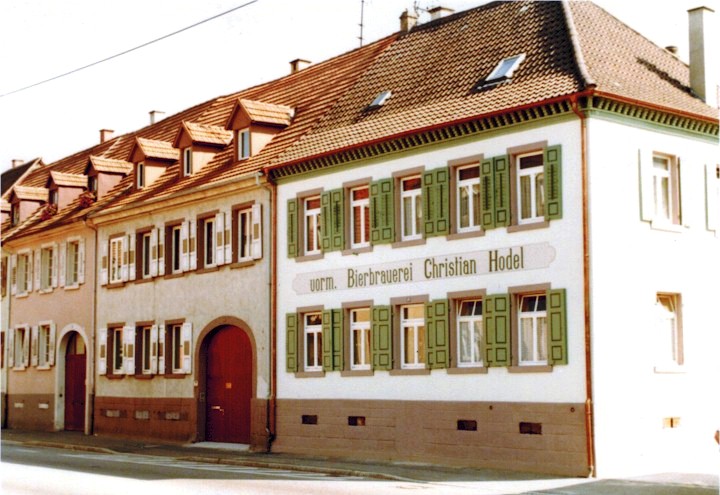 Gustav Hodel
was born on April 30, 1875, in Emmendingen, Baden, Germany. He was the
youngest of Christian Hodel and Christina Yoho's seven children.
Christian Hodel was the owner of the Hodel Brewery there in Emmendingen.
So Gustav was born to the brewing trade.
Gustav Hodel
was born on April 30, 1875, in Emmendingen, Baden, Germany. He was the
youngest of Christian Hodel and Christina Yoho's seven children.
Christian Hodel was the owner of the Hodel Brewery there in Emmendingen.
So Gustav was born to the brewing trade.
Gustav wrote to his
sister for money, and grudgingly returned to work for Martin Blum - but
only long enough to repay the debt and save enough money to leave again.
He then did a short stint with the Pabst Brewing Co. in Milwaukee, but
he was lured away by tales of adventure. Setting out for Alaska and the
prospects of a bear hunt, he joined another traveler - who was also
short of funds - by riding the box cars west.
By the time they had reached Montana, Gustav had had enough. He
continued as far as Silver Bow where he took a position at Christian
Nissler's Silver Bow Brewery. After one year he had saved $300, and
yearning to see the Pacific Ocean he set off again. In early '95, he
boarded a train for Portland where he caught a steamer down the coast to
San Francisco. Prospects were not good here, and after some
misadventures, an older but wiser Gustav decided to return to Montana.
He was fortunate to find a position with the
Centennial Brewing Co.
in Butte. The owner, Henry Mueller (also a native of Baden), took a
personal interest in the young brewer. Mueller persuaded Gustav to
settle down and save his money for brewer's school in order to further
his career. He was earning good money for the times and by 1899 he had
the funds to travel to Milwaukee and attend a six month course of
instruction.
The school was a joint venture of the Pabst and
Schlitz Brewing companies, with formal instruction in the morning and
practical applications at one of the breweries in the afternoon. At the
end of the six months, Gustav received his Master brewers certification.
Returning to Montana in early 1900, he was immediately given a new job
by his mentor, Henry Mueller. Besides owning the giant Centennial
brewery, Mueller had just established a new brewery in Billings, Mont.,
and the 25 year old brewer was to be the plant's first brewmaster.

He remained in Billings until January of 1902,
when he returned to Butte to help with another of Mueller's breweries.
Lewis B. Pabst was Mueller's partner and had been in charge of their
Olympia Brewing Co.
It was
during this period that Gustav met the young sister of two of his
brewers, Joseph and
John Weidenfeller. Mary had come to Butte from Dorr, Mich. to visit her brothers, and after
meeting the successful young Gustav, she decided to prolong her stay.
To again quote his grandson:
Gustav was inconsolable and lived a solitary life, believing no one
could take Mary's place. But finally, on February 8, 1908, he married
Anne Champagne, and they were soon to be blessed with the first of three
girls.
Gustav had been Centennial's superintendent since 1904, and his high
wages allowed him to invest in the mining boom going on in the area. He
was shrewd with his investments and on 28 October, 1909, Gus (which he
now
went by) was elected president of the Golden West Mining & Milling
Co., which was capitalized at $500,000. Late the following year, Gus
sold some of the shares in the gold mine, and traveled to Lewistown to
purchase an interest in the
Lewistown Brewing Co.
On 11 April, 1911, after raising additional funds, he purchased the
controlling interest in the Lewistown Brewery for $65,000. Gus then
assumed the position of president, and manager of the company.
The business flourished until January 1, 1919, when Montana chose to
adopt state-wide prohibition - one year and 15 days prior to national
prohibition. At this point, rather than close the plant, Gus decided to
produce near-beer and soft drinks. This allowed the plant to stay open,
but the demand for real beer was stronger than ever, and Gus was willing
to meet the demand.
Luckily the prohibition enforcement agents
were "few and far between" as well as being notoriously corrupt. In
November of 1922, former prohibition enforcement director, O.H. Shelly,
was indicted on 12 counts of accepting bribes. He had received money
from the Montana Brewing Co. of Great Falls, and the Lewistown Brewing
Co., with the understanding that he would allow them to make and sell
beer.
Other than making near-beer or illegal beer, there were no
options to brewers other than to leave the country, and some did. The
obvious choice would be Canada, but unfortunately they too were
experimenting with idiocy of prohibition. However, unlike the U. S. they
wised-up much sooner. As of January 1, 1924, the Province of Alberta
modified their eight year old prohibition law to the extent that beer
could again be produced.
On 31 December, 1923, Gus crossed the
border into Canada and headed to Medicine Hat, Alberta, with $2,000 in
cash from the sale of his Lewistown home. There he found local investors
and they re-opened the ten year old, Medicine Hat Brewing Co., which had
been idle for eight years. Gus was president of the company; H. C. Yuill²,
vice-president; and J. H. Yuill, secretary-treasurer.
Perhaps Gus' decision to shut down
was influenced by the voters referendum passed the previous November in
Montana. State-wide "dry" laws were repealed, which left enforcement of
national Prohibition to federal agents.
Gus was now back in
Lewistown and again making near-beer, and with relaxed enforcement he
was making stronger beer as well. Still, he had too much exposure and
was an easy target for the feds.
On Sept. 19, 1928, Gus' brewery
was raided and he and one employee, Ole Langland, were arrested. The
feds destroyed 800 quarts of beer and dumped 600 gallons from the aging
tanks. They also confiscated all of his brewing equipment.
Both Gus and Ole were released on $300 bond (about $3,700 today) and
were to be tried in Great Falls Federal Court on October 13th. Ole faced
the court and was sentenced to 60 days in jail, and fined $50. However,
Gus failed to appear and forfeited the $300, and was believed to have
departed for Canada to avoid what would surely have been a stiffer
sentence than his employee received.
Gus kept a low profile in Lewistown, and apparently the forfeiture of
the bond satisfied the Feds since they dropped the matter. He resumed
his brewing activities but was more circumspect. However, fate was to
deal him another set-back, when on October 29, 1929, the stock market
crashed. What investments he had left, including the Lewistown Brewery,
were lost.
Again, he found salvation in Canada. He traveled to
North Battleford, Sask., where an old acquaintance, Fred Wentzler,
offered Gus the position of brewmaster, with an outstanding wage of $350
a month. Wentzler had recently established the Star Brewing Company,
Ltd., and knew Gus from his days in Medicine Hat. The brewery initially
produced an "Old Fort Beer" but in October of 1930, Gus crafted what
would become their best selling beer - "Wentzler's Lager."
However, Gus was not content with working for others, and soon made
plans to re-open the abandoned Lewistown Brewing Company. He raised the
requisite capital through local investors, and by June of '34, his beer
was once again on sale. For his flagship brand, Gus crafted a lager beer
he named “Silver Tip” – which the locals call their grizzly bear. He
even signed his name to the label.
Gus remained in Lewistown as a sales
representative for the E. J. Johnson Co., the local beer distributor.
When Edmund Johnson unexpectedly died in March of '42, he agreed to stay
on at the urging of Johnson's widow. Gus left Lewistown in 1946,
relocating to California to be closer to his daughters.
He enjoyed retirement and found the milder climate of Santa Cruz more to
his liking. Gus had 20 years of leisurely, California living before
passing, on July 3, 1966.
Gus Hodel was considered to be one of
the Boarderlands leading brewers, and was a major contributor to the
brewing industry in his adopted homeland.
Martin Blum established
his brewery in 1890, with $20,000 in capital. It operated
successfully for 30 years until January 16, 1920, when Prohibition
shut it down. Martin died on October 17, 1919 - perhaps at the
prospect of his life's work being destroyed by a foolish law.
³ Gus crafted this “Old Fashion Lager” at Medicine Hat in 1924, but had also made an "Old Fashion Lager" as brewmaster with the Billings Brewery in 1900.
ACKNOWLEDGEMENTS: Portrait photo courtesy of Gus Hodel's grandson, Ronald
Matejcek Hodel Brewery photo courtesy of Gus' great-grand
nephew, Johnathan Hodel. Wentzler's Lager label courtesy of labelogist, Bert
Barkwell. And a special thanks to another of Gus' grandsons,
William "Bill" Whetton, For any comments, additions,
or corrections - please
contact me:
who's work made this biography possible.

Copyright © 2012 by BreweryGems ~ All Rights
Reserved.