Black Hills Brewery addition
ca. 1900
|
To locate a brewery in the Black Hills region of the Dakota Territory was a logical choice, especially in the late 1870s. Thanks to General George Custer's expedition to this northwestern section, gold was discovered at Deadwood Gulch in the Fall of '76. The resulting gold rush in the Spring of '77 had the Black Hills area booming. The larger towns of Deadwood, Lead City, and Central City, plus the smaller settlements of Gayville, Spearfish, Galena, and Sturgis were full of prospectors and miners, all thirsty for beer. There was no shortage of entrepreneurs seeking to quench this thirst, and brewers were quick to discover that easier riches were to be had in selling their liquid gold rather than in digging for the real thing. Deadwood The town of Deadwood was established in 1876, as a hastily constructed assemblage of tent, frame & canvas, and wooden structures. By 1877 these temporary shelters were being replaced with brick and frame buildings. There were a number merchants and outfitters selling to the miners, but there were a greater number of ventures devoted to other needs. The 1878 Business Directory for Deadwood listed 23 drinking establishments, including: "Miss Kitty" Leroy's Mint Saloon; Hisen & Welch's Snow Flake Saloon; Ludwig & Co.'s Senate Saloon; and Rosenkranz & Company's Central Saloon. There were also many regional breweries mentioned in newspaper accounts of the day. Most of these were small output operations meant only to supply the saloon belonging to the brewer - similar to brew pubs of today. In 1878 alone I found these enterprises: Lion Brewery; Star Brewery; Black Hills Brewery (owners of the Senate Saloon); Lead City Brewery; the Miners Brewery; the Parkhurst Brewery; and the Central City Brewery (owners of the Central Saloon). The wide open town offered a "hot" time, but it would heat up even more. In September of 1879 the "great fire" swept through the main business area leaving nothing standing in its wake. The town immediately commenced rebuilding, but this time with a decided preference for brick or stone over wooden structures. A couple of small breweries carried on into the early '80s, but the Black Hills Brewery was not among them. Its name sake would evolve from a venture started in nearby Central City by the owner of Deadwood's Central Saloon. This brewery would become the major producer of beer for the Black Hills region, and its Gold Nugget Beer would become the most popular. Central City In 1877 Henry Rosenkranz arrived in the boom town of Deadwood. He had heard of the riches to be gained in the Black Hills while working at a brewery in nearby Montana. With this expertise he set out to start his own brewery in Deadwood. However, with all the mining activity he didn't trust the local water supply. Instead he found a plentiful source from the Central City section of Deadwood Creek. This location was also nicely situated between Deadwood's revelry and Lead City's industry. He and partner Dan Warner built a modest wood frame structure and began brewing. The enterprise was an immediate success. Their teams of dray horses delivered kegs of their beer to the saloons, and beer halls around the mountainous region. Then just two years after start-up they had sudden surge in business. The Deadwood fire of '79 wiped out their much of competition, giving Rosenkranz and his partner an opportunity to supply many more beer halls than just their own Central Saloon. This unexpected influx of capital allowed Rosenkranz to buy out his partner in 1880. He then continued as a sole proprietor at the brewery, and added more saloons and beer halls to his portfolio. By 1882 he needed a larger plant to keep up with increased demand. So he purchased the nearby Phoenix Iron Works as a shell for the new brewery, adding an adjacent bottling works.
A historical account, written in 1884:
He was now bottling his beer under the brand name of Gold Nugget Beer. For the
following five years the business was good and Henry prospered. Then in 1889 the
Rozenkranz family suffered two serious blows. Statewide Prohibition forced Henry
to close the brewery, but the even worse was the death of his 31 year old wife,
Louisa. Henry was now left to raise their seven children by himself. South Dakota Prohibition (1889-1896)
Upon achieving statehood in 1889, one of the first laws to pass the new state
legislature was statewide prohibition. It was not a popular law, especially
outside the larger cities of Sioux Falls and Rapid City. In the Black Hills
region it was almost unenforceable. Once a drinking establishment was closed it
was immediately reopened in a new location. However, for a large operation like
a brewery this wasn't as easily accomplished. Yet the smaller brewing plants,
being more more portable, continued supplying the thirsty miners - in spite of
the law. Black Hills Brewing and Malting Company
By the mid-1890s it was apparent that the unpopular law was going to be
repealed, and so it was - in 1896. But anticipating repeal, a group of
principals of a first-tier brewery in Minnesota approached the Connors in late
1894. The following year a deal was struck and the Black Hills Brewery was under
new ownership. The Minneapolis Brewing Company 
While not owned by the Minneapolis Brewing Co. (MBC), the stockholders with
controlling interest in that company now also owned the Black Hills Brewery,
just as they too owned controlling interest in the North Star Malting Company of
Minneapolis. The Black Hills Brewing Company With the 1895 purchase of the brewery, the new owners made modest improvements, and then resumed production. Their first beer was Black Hills Export Lager Beer (above right). In 1900 the company was restructured and "Malting" was removed from the company's name, as they were no longer malting barley at this plant. Instead it was more cost effective to ship the needed malt from their own North Star Malting Company. The new officers were: Sigmund F. Wiedenbeck, president (and a MBCo supt.); Armin Neubert, vice president (and MBCo's production supt.); Gustav J. Heinrich, secretary (and MBCo's treasurer); and Hubert B. Schlichting, treasurer & manager (and a former MBCo general agent).
In 1900 the group also accomplished a major addition to the brewery utilizing the patented plant design of Armin Neubert. A new bottling works was also added at this time. The "Gold Nugget" brand was re-introduced (left), and another version of the Gold Nugget label depicting gold miners, was adopted - later to be used for their Ginger Ale (below). Neubert controlled production at the Central City plant as well as the Minneapolis plant, and by 1905 he had the SD plant's production up to 1000 barrels per month. He endured the 650 mile train ride between the two plants dozens of times in the following years. Often he would have extended stays to oversee a particular production issue. However, in 1914 he retired from the MBC and left Minneapolis for permanent residence in the Black Hills. He was now able to more closely monitor the breweries output. 
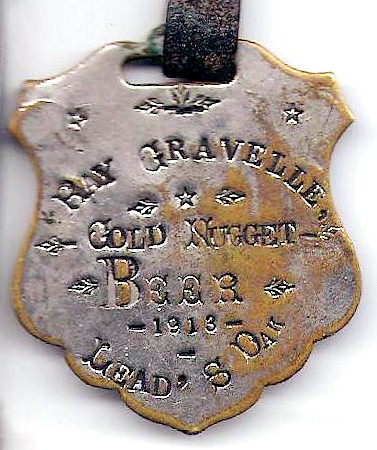
Cap lifter or "church key" ca.1912. It was meant to be placed
on a key chain and had the additional feature of a Prest-O-Lite
key. This square hole served as a wrench to open the valve on
carbide tanks located on the running boards of early autos. When
the valve was opened, it supplied gas for the headlights.
All contents including images are copyright by BreweryGems.com |
 With
the advent of Prohibition, Rosenkranz ceased his brewing operation and started
an ice & coal business. Within a few years this cold and uncomfortable business
was abandoned in favor of the warmth and gaiety of saloon keeping in his own
Central Saloon. The brewery was then leased to the team of Faulkner & Connor who
resumed operations under the name of the Black Hills Brewing and Malting
Company. The firm was soon owned by the Connor Brothers. They apparently
operated "legally" by producing near-beer, but more likely ignored the low
alcohol provision of prohibition since the law was not uniformly enforced.
With
the advent of Prohibition, Rosenkranz ceased his brewing operation and started
an ice & coal business. Within a few years this cold and uncomfortable business
was abandoned in favor of the warmth and gaiety of saloon keeping in his own
Central Saloon. The brewery was then leased to the team of Faulkner & Connor who
resumed operations under the name of the Black Hills Brewing and Malting
Company. The firm was soon owned by the Connor Brothers. They apparently
operated "legally" by producing near-beer, but more likely ignored the low
alcohol provision of prohibition since the law was not uniformly enforced.